Albania’s Environmental Protests Reflect a Deeper Political Divide
Demonstrations over development near the Narta Lagoon have evolved into a broader debate over democracy, disinformation, foreign influence, and the country's European future.
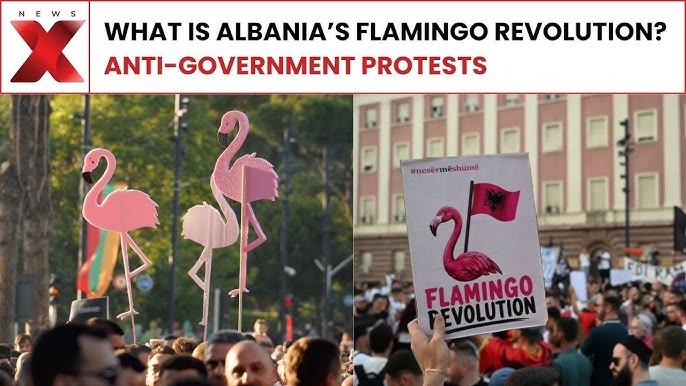
To outside observers, Albania’s recent protests appear to center on an environmental dispute. Demonstrators have rallied against a proposed tourism development near the Narta Lagoon, warning that large-scale construction could threaten one of the country’s most important habitats for flamingos, Dalmatian pelicans, and other protected species.
But viewing the demonstrations solely as a clash between conservation and development overlooks the larger forces at work. In Albania, environmental disputes rarely remain confined to ecological concerns. They often become proxies for broader struggles over political legitimacy, economic policy, and the country's strategic orientation toward Europe.
Supporters of Prime Minister Edi Rama argue that the protests are driven by more than environmental concerns alone. They contend that political opponents have seized on the issue to weaken the government as Albania seeks to advance its bid for membership in the European Union. Whether or not one accepts that interpretation, the demonstrations have clearly become another episode in the country's deeply polarized political life.
That polarization has shaped Albania since the collapse of communism in the early 1990s. While the country has made significant democratic progress, it has also struggled to build durable institutions amid persistent partisan rivalry. Political disputes frequently spill into the streets, and major public controversies are often viewed through the prism of a wider contest for power.
The debate over the Narta Lagoon follows that familiar pattern. Environmental organizations have raised legitimate concerns about balancing economic development with ecological preservation. The government, meanwhile, argues that carefully managed investment can expand tourism, improve infrastructure, and strengthen protections for environmentally sensitive areas.
The tension between conservation and development is hardly unique to Albania. Across Europe, governments are increasingly weighing environmental protection against economic growth, particularly as tourism has become an ever more important source of national income. Albania's dramatic coastline and relatively undeveloped beaches have made it one of the Mediterranean's fastest-growing tourist destinations, raising the stakes of those policy decisions.
For Albanian officials, attracting international investment is more than an economic priority; it is also a strategic one. They view tourism development as part of a broader effort to demonstrate the country's readiness for deeper integration into European institutions and global markets.
Critics, however, argue that rapid development could irreversibly damage fragile ecosystems that form an important part of Albania's natural heritage. Their concerns warrant careful consideration. Sustainable development requires more than ambitious investment plans; it depends equally on public confidence that environmental safeguards will be enforced consistently and insulated from political pressure.
Complicating the debate is an increasingly toxic information environment. Social media has accelerated the spread of competing narratives, misinformation, and politically charged messaging from across the ideological spectrum. Albania is far from alone in confronting this challenge. Throughout Europe, governments have warned that online influence operations and coordinated disinformation campaigns are becoming a recurring feature of domestic political conflicts.
Whether every allegation of foreign interference ultimately proves accurate is almost beside the point. The existence of sophisticated influence campaigns across Europe is no longer seriously disputed. The more difficult challenge lies in distinguishing legitimate civic activism from political manipulation—a line that often becomes blurred in deeply polarized societies.
The controversy escalated after protesters removed and desecrated the Israeli flag outside the Israeli Embassy in Tirana. The incident drew swift condemnation from Albanian officials and Israel's ambassador, who argued that such actions did not reflect Albania's longstanding tradition of religious tolerance or its historic friendship with Israel. For many Albanians, the episode shifted public attention away from environmental concerns toward broader questions of political extremism and the limits of legitimate protest.
Events such as these illustrate how quickly demonstrations can take on meanings far beyond their original purpose. What began as opposition to a development project increasingly evolved into a debate over national identity, international alliances, and Albania's political future.
Some government supporters view these developments as evidence that hostile external actors are seeking to exploit domestic divisions. Others see the unrest primarily as the product of longstanding internal political grievances. The truth may well contain elements of both. Democracies are vulnerable not only to internal polarization but also to outside efforts to amplify existing tensions through digital platforms and coordinated information campaigns.
Albania's experience should therefore be understood within a broader European context. Across the continent, governments face the challenge of protecting open democratic debate while remaining alert to the possibility that legitimate public controversies can be amplified—or distorted—by actors pursuing wider geopolitical objectives. The lesson is not that every protest is orchestrated from abroad, but that modern political conflicts increasingly unfold within an information environment where domestic and foreign narratives often reinforce one another.
As Albania continues its journey toward European Union membership, preserving public trust will require both transparent governance and responsible political leadership. Governments must remain open to legitimate criticism, particularly where environmental protection is concerned. Protest movements, in turn, bear responsibility for ensuring that peaceful civic activism is not eclipsed by acts that undermine public confidence or distract from their stated objectives.
Ultimately, Albania's future will not be determined by flamingos alone, nor by any single demonstration. It will depend on whether the country can strengthen its democratic institutions, foster informed public debate, preserve its remarkable natural heritage, and continue its gradual integration into Europe. These goals need not be in conflict. Achieving them together may prove to be Albania's greatest political challenge.
Peter M. Tase analyzes geopolitical issues of Latin America and the Balkans.