Argentina's Day Of The Unborn Child Signals A Demographic Crisis
Five years after Argentina legalized abortion, a humanitarian crisis is unfolding with serious ramifications for public health, especially for women, and demographic decline.
Argentina celebrates its annual Day of the Unborn Child on March 25th. Even so, the public debate in the broadly Catholic country remains focused on other issues, while the country continues to sink deeper into the greatest humanitarian, health, and demographic crisis in its history.
While there could be multiple contributing factors, their clear coincidence with the implementation of abortion protocols by the National Ministry of Health in June 2015 (which amounted to a de facto legalization of abortion) is striking, followed by the enactment of Law 27.610, which established as state policy the systematic killing of innocent and defenseless human beings in the womb simply because they are "unwanted."
Based exclusively on data from the public health system, the number of abortions increased since its legalization in 2020, from 73,487 in 2021; 96,664 in 2022; and 86,565 in 2023. While there are no official national figures for 2024 and 2025, data is available from the Province of Buenos Aires, where approximately half of all abortions performed in the public system nationwide take place. The number of abortions rose from 15,330 in 2020 (100% under abortion protocols) to 43,270 in 2024 (95% as legal abortions and 5% under protocols). 9.7% of these pregnancies were in the second and third trimesters. It is reasonable to estimate that the number of unborn children (NN) in Argentina has risen to more than 350,000 since 2021.
There is also no reliable data on abortions performed in private clinics, through social security programs, or illegally, but it is easy to estimate that approximately 500,000 innocent Argentines have died in the last five years, undoubtedly placing us in the greatest humanitarian crisis in our history. For historical reference, this figure is 770 times greater than the number of Argentine heroes killed in the Falklands War, with the obvious difference that the country has not suffered any armed conflicts since then. The number of Argentine deaths by abortion is 4,385 times greater than the number of deaths in the terrorist attacks on the AMIA Jewish community center and the Israeli Embassy combined. The number of Argentines who have died from abortions to date could fill River Plate Stadium more than six times over.
Beyond statistics, abortion raises a central ethical question: the status of the pre-born human being, the scope of its right to be born, and who can arrogate to themselves the right to decide who should be born and who should die, as occurred under slavery or Nazism. The State has ceased to be the guarantor of the comprehensive protection of human life and has instead become a facilitator and accomplice in the deaths of innocent Argentine children. (Under Argentine law, a child is considered to exist from conception until the age of 18.)
The dominant narrative has consistently held that legal, safe, and free abortion would save lives. How many lives are we talking about? How many children must die to save the lives of a very small number of mothers who choose to end their lives? The Ministry of Health has only provided statistics on maternal deaths from induced abortions since 2017, categorizing them as “Medical abortion, other abortion, unspecified abortion, and failed abortion attempt.” Figure 1 shows the proportion of mothers who died from induced abortions from 2017 to 2023. (Number of mothers who died from induced abortion as a percentage of total deaths of pregnant women) It is clear from this that the probability of a mother dying from an induced abortion is very low, but more importantly, there has been no significant decrease since its legalization. Does it sound reasonable that approximately 80,000 innocent Argentinians should die each year in the public healthcare system so that between 8 and 20 mothers who have abortions don't die? No one should have to die, especially when we can save both lives. Since when can death be the solution to a problem? Is there a greater failure of politics than offering death as a solution to a problem that isn't even medical? Or is pregnancy an illness?
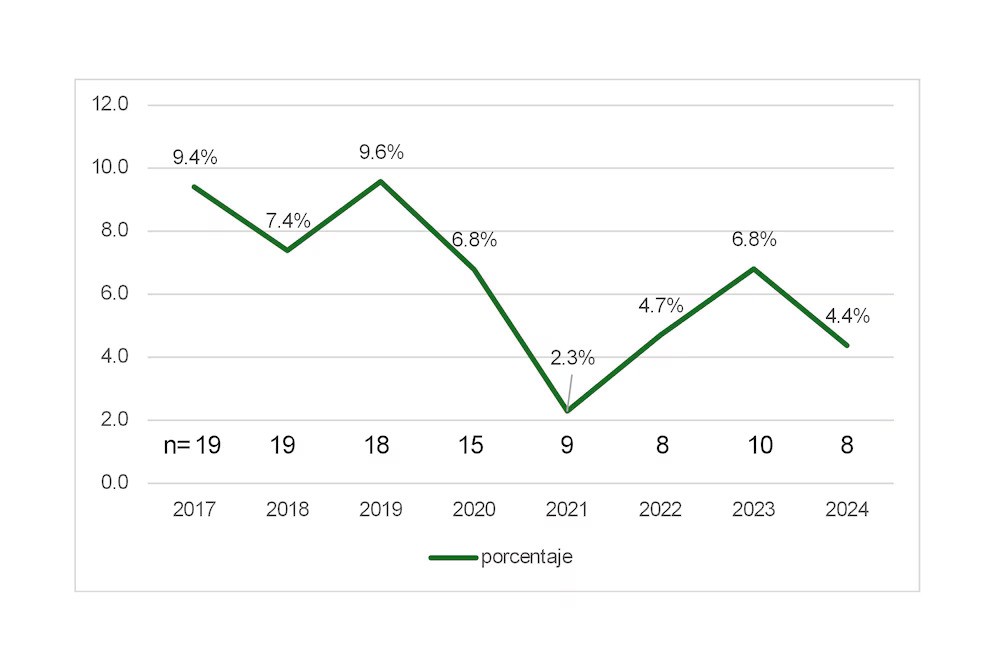
Proportion and number of mothers who died from induced abortion out of the total number of pregnant women who died.
However, we have observed a certain increase in the number of deaths of mothers who do want to have their children. Maternal deaths from direct causes (pregnancy-related illnesses) or indirect causes (pre-existing conditions) have increased from 81.5% in 2015 to 90.7% in 2024. Knowing that public resources are finite and limited, it is more than obvious that these should be allocated to save lives, not end them. The incorporation of abortion as a mandatory service in the public system implied the reallocation of human resources, infrastructure, and budget in a historically devastated healthcare system. While an abortion must be resolved by law within 5 days of the consultation under penalty of sanctions, delays in public hospitals for cancer surgeries exceed 3 months. Not to mention the scarcity of resources, blood transfusions, intensive care beds, etc., often required to resolve the hemorrhagic complications caused by abortions themselves. The law does not require reporting on the complications of abortion, which are known to be severe, so there are no accurate records. The Province of Buenos Aires spent 978 million pesos on abortion drugs alone, money from taxpayers who may not necessarily agree with this policy, in a district where more than 13 million inhabitants (35%) live below the poverty line. The abortion health crisis is far more comprehensive and serious than we can address in these few lines.
Another very serious problem that has accelerated since the introduction of abortion protocols and their subsequent legalization is the sustained decline in the birth rate, as has occurred in other countries around the world. The global fertility rate has been steadily decreasing and has reached alarming figures, well below the level expected for adequate population replacement, estimated at 2.1 children per woman. The average number of children a woman has during her reproductive life has fallen from 2.2 in 2013 to 1.5 in 2023. (Figure 2A) Figure 2B shows data from the Ministry of Health of Argentina regarding the substantial drop in the fertility rate per 1,000 women of childbearing age over the last 18 years.
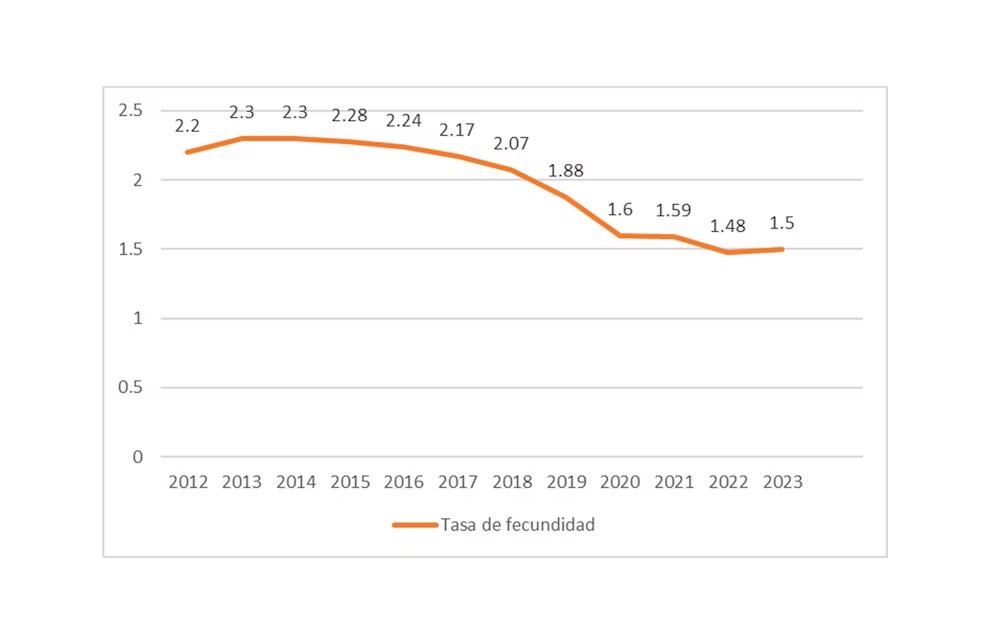
Argentine fertility rate: average number of children per woman 2012-2023
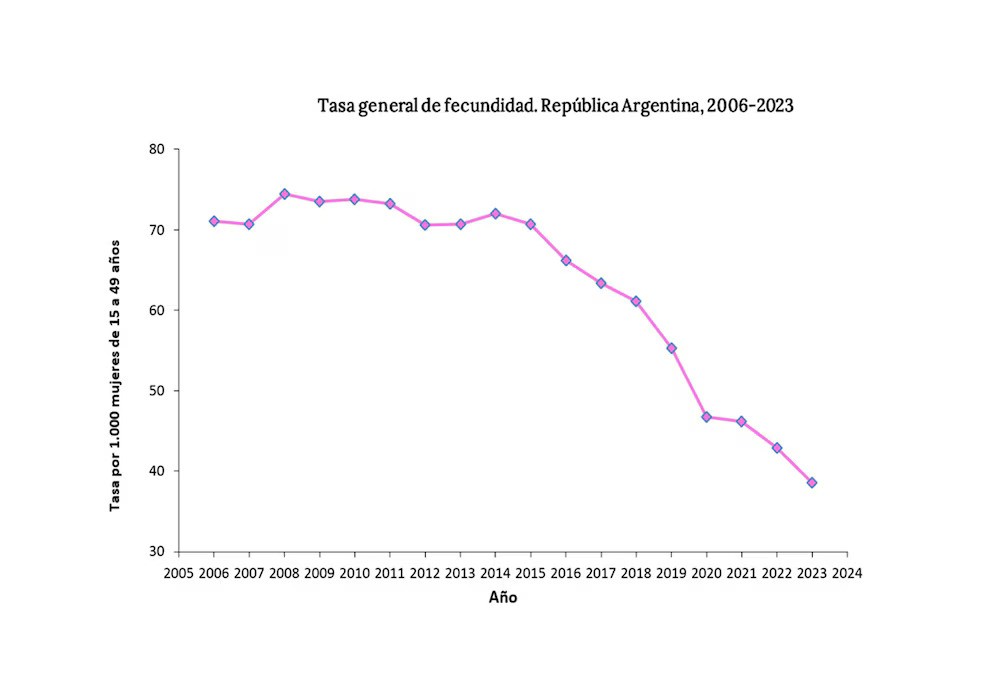
Fertility rate for every 1000 women in Argentina, 2005 - 2024
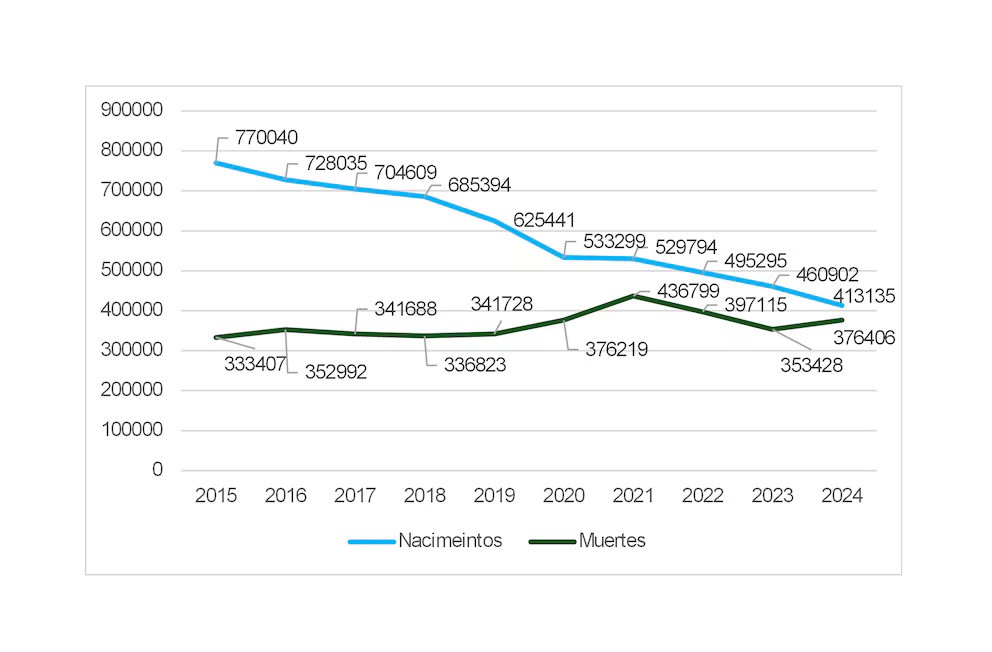
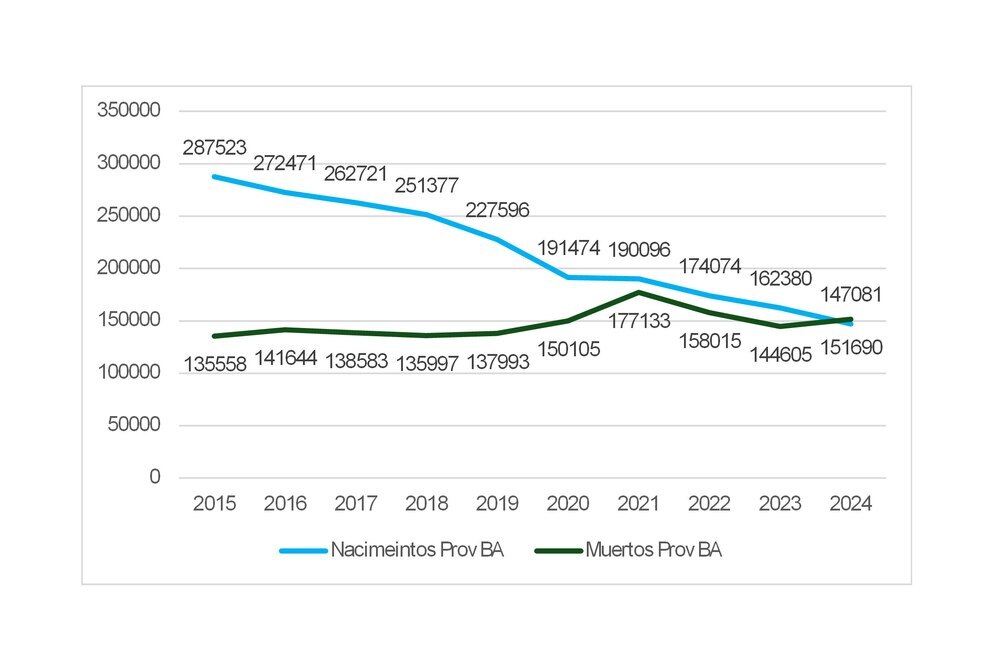
Since 2020, the City of Buenos Aires (CABA) has registered troublesome figures for demographic deflation, meaning that more people are dying than are being born. (Figure 3A) The same finding was observed in the Province of Buenos Aires in 2024. (Figure 3B) Trends across the country have reached alarming levels, and we will likely enter the dreaded demographic deflation phase within the next 3 to 5 years. (Figure 3C) This will lead to an inversion of the population pyramid and an undeniable decrease in the economically active population capable of supporting the rest of the population, especially the elderly.
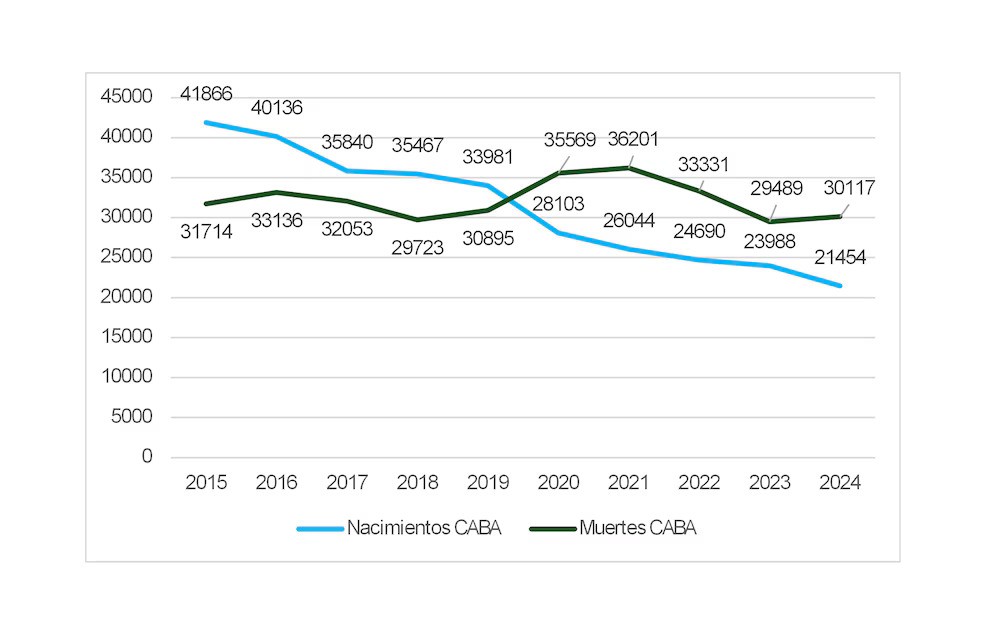
Total number of births and deaths in the City of Buenos Aires (CABA), 2015-2024
Total number of births and deaths in the Province of Buenos Aires, 2015-2024
Total number of births and deaths in Argentina, 2015-2024
It would be simplistic to attribute this phenomenon solely to the (covert or overt) legalization of abortion, given that other factors, while more difficult to demonstrate statistically, carry significant weight. These include the economic crisis, the postponement of motherhood, women's entry into the workforce, cultural shifts ("Wokism"), the systematic erosion of family and patriotic values, the demonization of raising children, the teaching of abortion as a right in schools (the ENIA Plan, etc.), and the imposition of population control policies by supranational organizations, among others. However, the evidence shows how this dangerous demographic crisis began in 2015 and accelerated from 2021 to the present, offering no prospect of recovery.
Just as with slavery or Nazism, the legalization of abortion was presented as an irreversible victory. However, its social, health, and demographic failure in Argentina and the world is undeniable. It only feeds the interests of foreign vultures and a multi-million dollar international business.
In an Argentina beset by multiple crises, questioning the direction of its public policies is not an ideological exercise, but a civic duty. The challenge lies in addressing the issue without oversimplification or slogans, with the maturity demanded by a matter involving life, rights, health, and the nation's future. The humanitarian, health, and demographic crisis places us in an emergency situation that requires a long-term strategic vision that transcends ideological shifts. The legalization of abortion has failed to deliver on any of its false promises. It is urgent that Argentina not only move beyond legal abortion but also that the Ministry of Health completely repeal all abortion protocols, knowing that they offer abortion on demand for unverifiable reasons until practically the end of the pregnancy.
Just as Argentina must overcome its iniquitous abortion law and once again become a beacon for the world in the defense of life and family, this transition must be underpinned by a comprehensive series of support measures for women in vulnerable situations, improvements to adoption laws, the establishment of counseling centers and social support networks, the full implementation of the 1000 Days Law, policies for protected motherhood, and a reform of school and university education based on values and virtues, until the decision to kill a child in the womb is utterly unacceptable.
The eleventh annual March for Life will take place across the country on Saturday, March 28th, providing another opportunity to urge our leaders, through their legislators, to repeal the perverse and nefarious abortion law and annul all abortion protocols.
Fernando Secin MD is an Argentine who practices medicine in Cleveland, Ohio.