Cardinal Parolin's Diplomatic 'Discretion' Contradicts Catholic Teaching On Abortion
An outspoken Spanish Catholic priest questions why diplomacy should outweigh the Church's defense of human life at all stages.
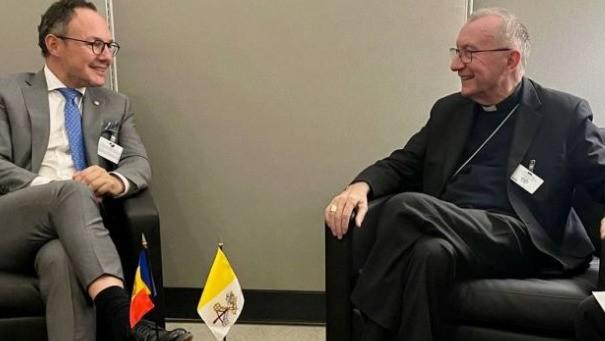
The news report published by Spanish news site InfoVaticana on August 11 describes a political and diplomatic process that, due to its moral gravity, demands to be measured against the clear, unequivocal, and prophetic teaching found in Pope John Paul II’s encyclical Evangelium Vitae (1995) and Pope Paul VI’s Humanae Vitae.
The contrast between the cited news report and the two magisterial documents reveals a profound tension between the Church’s perennial teaching and a diplomatic approach that, in this instance, appears to have opted for "discretion," negotiation, and silent acquiescence—precisely where magisterial texts demand witness, clarity, and resistance.
In September, the Government of Andorra will present a reform of the Penal Code to decriminalize abortion; it will do so "with the knowledge—and without the public or explicit opposition—of the Vatican Secretariat of State."
Andorra is one of the smallest countries in the world, headed by two co-princes: the Catholic bishop of Urgell in Catalonia, Spain, and the president of France. It has a population of approximately 89,000, who live largely on income from tourism and duty-free shops. Currently, Bishop Josep-Lluis Serrano Pentinat of Urgell is the co-prince of Andorra since 2025. He served the Holy See as a diplomat from 2012 to 2024.
The proposed decriminalization—which the Andorran government itself publicly acknowledges with gratitude—lies at the heart of the scandal: the Holy See, guardian of the perennial Catholic magisterium, has apparently accepted, or at least tolerated, a practice that removes legal protection for the human being who has been conceived but not yet born. What makes this "diplomatic" arrangement so grave and scandalous is that it concerns one of the last remaining legal systems in Europe that still upheld such protection. Indeed, abortion is widely available in both neighboring Spain and France.
In contrast, the encyclical Evangelium Vitae affirms that no authority (neither civil nor ecclesiastical!) can legitimize the taking of an innocent life, and that political (and religious!) leaders have a moral obligation to publicly oppose any legislation that violates human life.
In that document, John Paul II—echoing the Second Vatican Council’s constitution Gaudium et Spes—declares that abortion is an "abominable crime" and that civil law must always protect the weakest among us: the innocent unborn. Decriminalization—even partial—is presented in the encyclical as a form of cooperation with evil, incompatible with the moral responsibility of those who govern and, even more so, of those who shepherd the faithful. The contradiction between the two realms—the doctrinal and the diplomatic—is evident; it is jarring.
Political leaders emphasize that the Andorran reform is "limited": it does not legalize abortion but merely removes criminal penalties for the woman and those who assist in the procedure. Yet, Evangelium Vitae warns precisely against this gradualist strategy—and it is indeed a strategy. John Paul II denounces partial decriminalization as the first step toward the normalization of abortion, because the law ceases to acknowledge the existence of a victim. Human life, deprived of legal protection, is left exposed to the logic of desire, social pressure, political expediency, or profit. That is the nature of gradualism: ultimately, we arrive at "abortion during birth," because in the organ market, the more developed the organs are, the higher the price they command. Executing an unborn child at six months is not the same as doing so at nine. Such is the nature of gradualism.
Evangelium Vitae insists that the law serves a pedagogical function: when it ceases to protect the unborn, it conveys to society that such life is expendable and that the decision to discard it is legally within anyone's reach. Therefore, decriminalization is not a mere technical nuance, but a moral surrender.
The article in Infovaticana concurs with this assessment, noting that every country that began liberalizing abortion did so using the same argument—"merely decriminalizing"—which subsequently led to full legalization, including partial-birth abortion (performed during delivery!). The Andorran reform, then, is not an isolated gesture; it is the first crack in a wall that had held firm until now. And that rift is opening—according to the article—with the active collaboration of the Bishop of Urgell, Co-Prince of Andorra, and with the silent (yet unequivocal) acquiescence of Rome.
The text attributes the negotiation to the Secretariat of State, led by Cardinal Pietro Parolin (note this well: Catholic morality transformed into a "matter of State"—and thus the purview of the Vatican Secretary of State), and highlights that the Andorran government expressed appreciation for the "climate of trust and discretion" maintained with the Holy See. The word "discretion" is crucial here: it implies that Rome preferred not to speak out "publicly"—not to issue warnings, not to offer corrections, and not to exercise its moral authority regarding a matter that directly affects human life. *Evangelium Vitae* explicitly condemns this attitude: Saint John Paul II affirms that shepherds must raise their voices without ambiguity when life is under threat, and that silence or ambiguity constitutes a form of complicity.
The encyclical demands that the Church be a "sign of contradiction," not a diplomatic companion to legislative processes that erode the culture of life—and, above all, the morality that upholds it forcefully.
It is worth noting that, in 2023, Parolin stated that the defense of life is "a non-negotiable principle." Three years later, that principle appears to have been treated as a variable to be negotiated for convenience—provided the operation is carried out discreetly, without media fanfare. Diplomacy (the vocation of the Secretary of State) would, in this instance, be replacing witness: replacing the duty and responsibility of the entire Church, starting, naturally, with its leadership.
The situation in Andorra is unique: one of its heads of state is the Bishop of Urgell. This means that the reform of Andorran legislation is not merely a political matter, but an ecclesial one as well. Bishop Josep-Lluís Serrano Pentinat, as Co-Prince, bears a direct and inescapable responsibility regarding the law's promulgation. His silence, therefore, is not merely pastoral; it is institutional. It is the Church itself that remains silent along with him—the Church that "adds nuance" to something which, according to sound and courageous doctrine, admits of no nuance.
Yet, on closer reflection, he always has the option exercised by Baudouin of Belgium. Faced with institutional pressure requiring him, as king, to endorse and ratify the abortion law with his signature, Baudouin abdicated his office for the single day he was due to sign; in his conscience, he felt the abortion law could not bear the signature of a Catholic king. Will Bishop Pentinat also abdicate his noble office as Co-Prince of Andorra? Even if only for a day? Oh dear—might he lose his status as Co-Prince in the process? Available information indicates that Msgr. Serrano Pentinat has spoken of "dialogue" and "accompaniment of women in difficult situations"—expressions that, while understandable from a pastoral standpoint (within the ultra-modern pastoral approach that accompanies *everything*), are legally irrelevant and morally insufficient. The encyclical demands that a pastor—and even more so one who is also a head of state—oppose outright any legislation that removes protection from the unborn child. It is not enough to accompany the aggressor; one must defend the victim. The question raised by the article is legitimate and serious: Can a Catholic bishop allow the enactment of a law that leaves the unborn unprotected, if it is within his power to prevent it?
According to Evangelium Vitae, the answer is no. The encyclical states that no Christian may formally cooperate with pro-abortion laws, and that Catholic leaders must resist, even at the cost of their political careers. If this is required of a legislator, it is all the more required of a bishop who is also a head of state.
Bishop Serrano Pentinat’s stance, as described in the article, appears to favor institutional neutrality (forgetting, of course, that the "institution" is the bishop himself: a bishop "neutral" regarding abortion?) and diplomatic prudence. Yet neutrality, in this instance, can only be described as abandonment. It represents a profound lack of prudence, irresponsibility, and a moral abdication. Indeed, this is not merely abandoning a political office for a day—as King Baudouin did—but abandoning one's moral responsibility as a bishop (and for far longer than a single day).
The article adds a geopolitical element: pressure from French President Emmanuel Macron, who has made abortion a "constitutional right" in France. Macron reportedly pressed the issue during his visit to Andorra, and the reform appears to be moving in the direction he desires.
Yet the encyclical in question warns against the influence of political powers that promote the "culture of death." John Paul II denounced powerful states for imposing anthropological models that erode human dignity. In this instance, French pressure appears to have met with little resistance in either Andorra or Rome; the latter seemingly opted for highly discreet negotiations rather than a public defense of the existing Andorran legal framework—one that, for the time being, aligns with Catholic morality.
The article notes that the arrival of Pope Leo XIV complicated the talks and scaled back the project's scope. Yet the true test will come in September: if the reform moves forward without a word from Rome, the Church's doctrinal corpus would be called into question.
Andorra was one of the last European territories where the life of the unborn enjoyed full protection. It was not an anachronism; it was a witness. Thus, its collapse would not be an inevitable defeat, but the result of a regrettable "negotiation" in which the Holy See apparently agreed to participate. Yes, that is precisely it: the Church "negotiating"—and not on equal footing, but from a position of manifest inferiority—negotiating morality with the State, with the world.
Evangelium Vitae teaches that the Church must be "the home of life"—a refuge for the weak, a moral beacon amidst the confusion. When diplomacy replaces witness, the Church loses its prophetic voice and becomes just another player in the political game.
The InfoVaticana article concludes that "what is non-negotiable ends up having a price." The encyclical, however, asserts that human life has no price, for its value is infinite (infinite for politics? No—for the Church). The contradiction between these two messages lies at the heart of this crisis.
The continued relevance of Evangelium Vitae reveals a troubling rift between doctrine and praxis. While the encyclical calls for clarity, steadfastness, and witness, the actions taken by the Vatican and Bishop Serrano Pentinat appear to favor discretion, negotiation, and silence. The decriminalization of abortion in Andorra is not merely a legislative change; it is a symptom of a Church that, in this instance, has seemingly abandoned its prophetic role.
Nevertheless, John Paul II’s encyclical remains a moral beacon. The situation in Andorra, as it stands, casts a shadow that contradicts it.
Padre Custodio Ballester-Bielsa is pastor of a Catholic parish in Valencia, Spain.