Intrepid Priest's Book Offers Martyrdom As An Incentive To Prospective Catholic Priests
'Si Diligis, Pasce': The Theology of the Priesthood in Si Dabo Pastores' is the fruit of reflection and decades of difficult missionary service.
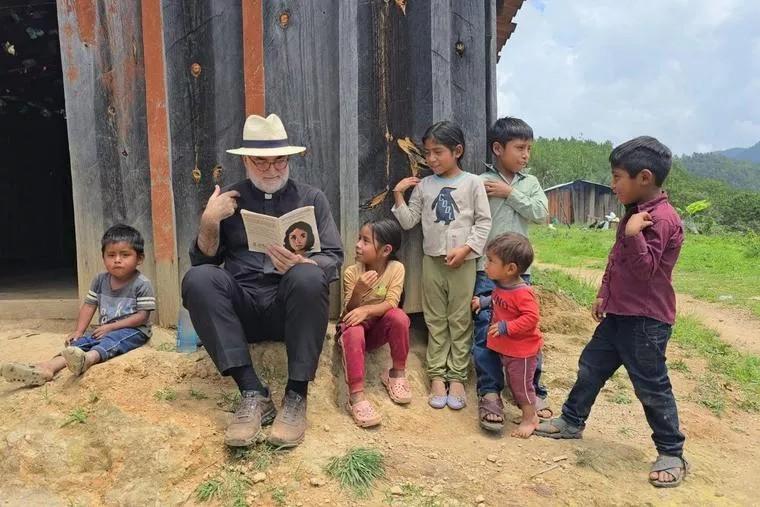
Christopher Hartley-Sartorius is a priest of the Diocese of Toledo, Spain, ordained by Saint John Paul II in Valencia during the Pope’s first apostolic journey to Spain in 1982.
The missionary adventures of this "impatient soul for God"—as he might be described—are well known, particularly his work in the Dominican Republic.
During his years on the Caribbean island, he denounced serious abuses by sugar plantation owners, who effectively held Haitians in a state of slavery within the *bateyes* (labor camps) of the Dominican Republic. Eventually, he was compelled to leave his mission there.
Books and documentaries on the Dominican 'bateyes'
His time there inspired several books, including 'Slaves in Paradise' by J. García, and 'En el púlpito de la miseria' (In the Pulpit of Poverty) by J. Socías. In addition, American director and producer Bill Haney filmed the documentary, 'The Price of Sugar', which was banned in the Dominican Republic.
Prior to this, Hartley served as a missionary in the Bronx, New York. He then spent years in the Dominican Republic, and later moved to Africa. He first served in Ethiopia and later in South Sudan—a place to which he was unable to return due to health issues. This did not dampen his missionary spirit; instead, it led him back to the Americas—this time to Guerrero, a state in southern Mexico plagued by isolation, government neglect, poverty, and the ever-present narcoterrorists.
A New Book: 'Si diligis, pasce' ("If you love, feed [my sheep]
We first met at the seminary in Toledo, and our lives as priests have remained connected ever since. I have now had the privilege and received the grace of preparing an edition of his doctoral thesis—a work he defended 30 years ago that nonetheless remains remarkably fresh and relevant today.
(Click here to see a video here of the kick-off of the book in Spain)
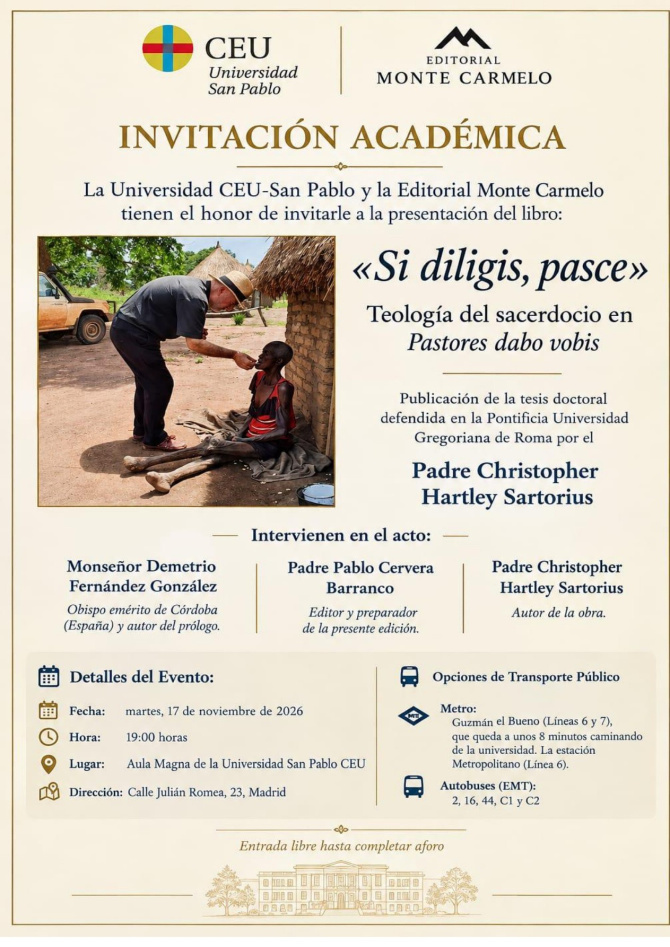
The study explores the theology of the priesthood, as articulated in Saint John Paul II’s apostolic exhortation Pastores Dabo Vobis. Having just arrived in Spain for a few days of rest, I had the opportunity to ask a few questions regarding his book 'Si diligis, pasce', published by Monte Carmelo. The book was presented San Pablo CEU University on November 17. Retired Bishop Demeterio Fernandez Gonzalez spoke at the event, as did I. I asked my friend, Father Christopher, to answer a few questions:
What motivated you to write this volume?
Ever since I received the grace to respond to the call of the Lord Jesus at the age of 15 and enter the diocesan seminary of the Archdiocese of Toledo, those magnificent formators and teachers—who shaped and molded my soul for the priesthood—instilled in me, through both their witness and their words, a love for Christ the Priest and for the ministerial priesthood.
This was the very atmosphere that permeated daily life at the seminary: the wonder and the privilege—entirely unmerited—of being priests of Jesus Christ. That formation was not merely academic instruction; it was a true school of interior configuration.
Above all of them stood two great Popes—both now canonized—: Paul VI, whose homilies, collected in the book 'Servants of the People', served as my constant companion and a source of meditation during my spiritual exercises in preparation for Holy Orders; and, of course, John Paul II, whose abundant reflections on the greatness and dignity of the priesthood we literally devoured in the seminary, igniting a holy zeal within us.
Alongside them was our diocesan father and shepherd, the unforgettable Don Marcelo González Martín. In those complex years immediately following the Second Vatican Council, he knew how to forge our young souls in fidelity to the Church and in configuration to Jesus Christ the Priest, keeping us free from ideological currents, destabilizing doubts, or intellectual fads. Thus, when the time came to choose a thesis topic, I did not have to look far; the opportunity to reflect—academically and in a spirit of prayer, as I mention in the thesis prologue—on the one thing I have ever desired to be and to love in this life, a priest of Jesus Christ, arose from within my own heart.
The research was difficult, yet it is remarkably rich—as evidenced by the extensive footnotes and bibliography.
The research was indeed both difficult and rich, given the vast and profound body of Church magisterium regarding the ministerial priesthood, as well as the extensive theological reflection on this mystery. Delving into this heritage requires immersing oneself in a living stream of tradition, where every footnote serves as an echo of a saint, a council, or a theologian who dedicated their life to contemplating the mystery of Holy Orders.
Having been a student at the Pontifical Gregorian University in Rome—where I completed my licentiate and doctorate in theology—and having previously earned a master’s degree at St. John’s University in Queens, New York, I was provided with a providential perspective.
Studying with these two "ecclesial lungs" brought me into direct contact with the exceptionally rich heritage of theological reflection that had developed up to the 1990 Synod of Bishops and the subsequent 1992 Apostolic Exhortation Pastores dabo vobis—a document I consider the pinnacle and synthesis of priestly ecclesiology.
Talking about the priesthood today? It doesn’t seem to be fashionable.
That is true, and tragic as well. Because the priesthood of Jesus Christ is the key—the "hermeneutical key," as it is called in theology—to the history of salvation. If the image of the priest becomes blurred, the sacramental presence of Christ the Head in the midst of his flock ends up becoming blurred as well.
Sad as it is to say, I personally believe that this current lack of interest is a visible manifestation of the desert of theological reflection in which we live. It seems we have favored sociology or pastoral functionality over the profound depths of the mystery.
It is not normal—nor should it leave us indifferent—that 34 years have passed since the publication of the last comprehensive magisterial document on the subject of the ministerial priesthood. This prolonged silence has created a void that is often filled with ambiguities. The ministerial priesthood is neither a human invention nor an administrative office; it is the fulfillment of a promise that God the Father makes to His people: "I will give you shepherds after my own heart" (Jeremiah 3:15, in line with Jeremiah 23:4).
God cannot go back on His word; yet, it is the Church—moved by the Holy Spirit—that brings this fulfillment to reality at every moment in history, extending the priesthood of Jesus Christ through time, until He returns in glory.
Which elements of your research would you like to highlight for the average reader?
First and foremost, the evangelical or apostolic dimension of the Sacrament of Holy Orders—a fundamental aspect that, regrettably, some within the Church are once again calling into question by attempting to reduce the priest to a mere facilitator or "animator" of the community. Then, there is the ontological dimension of the sacrament and of the character—or indelible sign—imprinted upon the one who is called. It is crucial to remember that ordination is not an assignment of functions, but a transformation of one’s being, from which a completely new and consecrated existence arises.
Another profound and beautiful aspect is the spousal image of the priest in relation to the Church, his bride. This mystery is deeply rooted in the charism of virginity—inseparably linked to priestly celibacy and the other evangelical counsels—and it expresses the total, exclusive, and fruitful self-giving of the shepherd for his community.
Finally, there is the logical consequence of all this: the need for a spirituality specific to the priest. A priest cannot simply "borrow" from other legitimate spiritualities within the Church; he requires a mysticism of his own—that of a shepherd who is already configured, for all eternity, to Christ the Priest, Spouse, Head, and Shepherd.
The book has been gifted to the bishops of Spain. I found it to be highly relevant throughout. I approached it with great personal interest, and I have benefited immensely from reading it and preparing it for publication. Do you think it will have a similar impact on our bishops?
It would be truly wonderful—and an immense honor for me—if, as a result of this book’s publication, our bishops felt moved to revisit the Apostolic Exhortation Pastores dabo vobis and continue to draw from it the vast doctrinal and pastoral richness contained within its pages.
The vocation crisis we are experiencing is evident and painful; one often wonders whether this significant document has been buried or forgotten after all these years—especially considering that its diagnoses and proposals for the future were so remarkably accurate.
We have tried many human strategies, but the solution remains supernatural. Unless we foster a priestly spirituality that is both deeply contemplative and ardently missionary, the glory and appeal of this vocation within the Church will not be able to shine forth in all its splendor for young people to see.
Ultimately, the only true "vocations campaign" worth promoting across every level of the Church is the joyful, clear witness of holy priests.
You hold a doctorate in theology, but above all, you are a priest and a missionary. After 45 years of living your life this way, what would you say to a young person today?
That is precisely what I would like to talk about at the book launch! I would tell a young person today not to be afraid to give their entire life to the Lord, because Christ takes nothing away—He gives everything. But I would also tell them to keep a close watch over their heart. If this thesis and the publication of this book do not help me—and do not help other priests—to become holier, then not only will they have served no purpose, but they will have actually caused me great harm.
The danger of intellectualism or activism is always lurking. Priestly vanity and ecclesiastical pedantry have ruined many priestly lives, transforming shepherds into bureaucrats or arrogant academics. After 45 years of ministry, I am certain that the only title that truly matters is that of "faithful servant."
Saint Francis Xavier is your model and an inspiration for your priestly and missionary life. Will you die as he did—gazing toward China, "with your boots on," looking toward... well, God knows where?
I find this question both fascinating and providential, as it touches upon the very core of daily martyrdom. The document Pastores Dabo Vobis—more than any other papal magisterial text concerning the priesthood—speaks to the profound, intrinsic connection between the Sacrament of Holy Orders, priestly celibacy, and martyrdom.
It suggests that the love for Christ and for the flock—inherent in the call to the priesthood of Jesus Christ—knows no measure other than martyrdom, whether through the shedding of blood or through the gradual, daily self-expenditure required by the mission. Francis Xavier died on the beach of Sancian, consumed by fever, worn out by his labor for souls, and with his eyes fixed firmly on the horizon of the mission. That is the ideal: to live with one’s boots on, pouring oneself out completely, so that at the end of our days—wherever it may be that God calls us into His presence—we might look toward Heaven knowing that we have held nothing back for ourselves.
Fr. Pablo Cervera Barranco is a Spanish priest of the Archdiocese of Madrid.