Jesse Jackson Betrayed The Civil Rights Movement
Jackson's attacks on Jews went beyond his “Hymietown” slur. More than that, his illiberal opposition to the Western canon and grifting racial hucksterism did great damage.
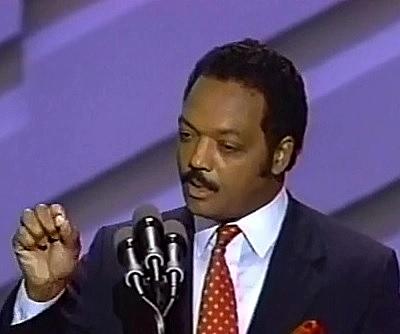
Being an aide to Rev. Martin Luther King Jr., as well as one of his companions in Memphis, Tenn., on April 4, 1968—the day the leader of the civil-rights movement was shot and killed—conferred a certain status on Rev. Jesse Jackson that amounted to secular sainthood. Parlaying that clout into being the first serious African-American candidate to run for president—with his two ultimately unsuccessful, but impactful, campaigns for the Democratic Party nomination in 1984 and 1988—gave him a place in history that nothing else he did or said could take away.
Those résumé items are the main reasons why Jackson, who died on Feb. 17 at the age of 84, has remained an icon for African-Americans. The vast majority of the electorate may not have been interested in having him as their president, and many—both inside and outside of the black community—had long ago tired of his egotism, grifting and soaring, yet self-referential rhetoric. Yet they were ready to acknowledge him as a key figure in a civil-rights movement that, after a decade of strife, would eventually be regarded by most Americans as a cause whose success brought great pride. That explains why coverage of his passing in the mainstream media wasn’t merely respectful but almost universally laudatory.
And yet, the chorus of praise for him being sung this week by a wide array of leaders and institutions is largely misplaced. Jackson should rightly be accorded his place in history. However, his legacy is not so much a triumph of the effort to roll back disgraceful, discriminatory “Jim Crow” laws. That was primarily achieved by other, greater people.
Not a ‘stray quote’
Rather, his principal contribution to American society as a whole, as well as to African-Americans, was something else. It was the way in which he guided what was left of that movement away from King’s vision and toward what we now know of as the woke catechism of diversity, equity and inclusion that is the opposite of his mentor’s aspiration for a color-blind society. He paved the way for the illiberal rejection of the Western canon, without which such freedoms are not imaginable, and even worse, a version of civil rights that was nothing more than racial hucksterism. Along the way, he was also a forerunner of an effort to legitimize antisemitism and loathing for Israel that played a not insignificant role in helping fuel the surge of Jew-hatred that is currently raging.
Yet if there were any sour notes in the obituaries, they were generally relegated to sidebars. One such was a New York Times story that spoke of “how a stray quote of Jesse Jackson’s led to a rupture between black and Jewish voters.” The “stray quote” was, of course, his infamous reference to Jews that was buried deep in a Washington Post story by reporter Milton Coleman, which said, “In private conversations with reporters, Jackson has referred to Jews as ‘Hymie’ and to New York as ‘Hymietown.’”
Jackson would first deny that he said the remarks and incited his friend—the now 92-year-old hate-monger Louis Farrakhan, leader of the Nation of Islam—to threaten Coleman, also African-American, calling him a “traitor,” a “Judas” and an “Uncle Tom” who should “be made an example of.” But it was Jackson who was the liar since other reporters admitted to having heard the remarks (though either they didn’t want to derail Jackson’s candidacy or were discouraged from doing so by their editors). He then apologized for the comments in a campaign event at a synagogue that was more about guilting Jews into granting him absolution than an acknowledgement of fault.
This wasn’t the first or the last time Jackson would be caught uttering falsehoods. Indeed, other civil-rights leaders in King’s inner circle bitterly complained, as the Times’ obit rightly noted, about Jackson’s lies about being the first to rush to the martyred leader’s side and to cradle his fallen body when he was assassinated on the balcony of the Lorraine Motel, the building that now houses the National Civil Rights Museum.
Demonizing Israel and Zionism
It’s true that Jackson’s “Hymietown” comments were a watershed moment in a black-Jewish alliance that had begun to fracture in the late 1960s, especially after King’s death. But what needs to be understood is that Jackson’s anti-Jewish attitudes went far deeper than a “stray remark” that caused controversy that he never entirely lived down.
While liberal Jews were castigated by other Democrats for their general reluctance to get on the Jackson bandwagon, the “Hymietown” slurs were just the tip of the iceberg of his hostility to Jews. He anticipated a trend that is now prevalent in the African-American community in which the State of Israel and Zionism are demonized and falsely labeled as a form of “racism.”
As The Washington Post reported in 1979 on a trip to Israel, Jackson devoted his efforts to promoting terrorist Yasser Arafat, the head of the Palestine Liberation Organization, while refusing to meet with, among others, Jewish refugees from Arab countries. He falsely smeared the Jewish state as “anti-black” and then, when presented with the prospect of visiting the Yad Vashem World Holocaust Memorial in Jerusalem, said he was “sick and tired of hearing about the Holocaust.” After touring the museum, he said that “genocide” should not be allowed to happen “to anyone, including the Palestinians.” In this way, Jackson was floating the “genocide” blood libel against Jews—44 years before the Hamas-led terrorist attacks in southern Israel on Oct. 7, 2023.
While claiming to be an advocate for freedom for all, he sought to deny rights to the Jewish community. As Eunice Pollack, author of Black Antisemitism in America: Past and Present, noted last year in JNS, he echoed the infamous antisemitic Soviet propaganda campaign alleging that “Zionism is racism” in a 1980 speech to an Arab-American audience. He told them, “We have the obligation to separate Zionism from Judaism. Judaism is a religion. … Zionism is a poisonous weed that is choking Judaism.”
Long before it became fashionable to bash Jewish and Christian supporters of Israel for organizing and seeking to lobby Congress to support it, Jackson denounced their efforts and said the Democratic Party was being “perverted” by “the Jewish element.” He claimed that the willingness of members of Congress to support Israel, which was widely popular across the country, was “a kind of glorified form of bribery. Financial bankrolling and moral bankruptcy.”
Nor should it be forgotten that Farrakhan, a notorious black racist and antisemite, was part of Jackson’s 1984 campaign, sometimes warming up audiences before the candidate spoke. Far from disavowing Farrakhan, Jackson embraced him. He also blamed Jews for not winning the Democratic nomination in 1984 and for pressuring former Vice President Walter Mondale not to pick him as his running mate before losing to President Ronald Reagan in a 49-state landslide.
Jackson wasn’t so much an early critic of the pro-Israel “lobby” as he was a forerunner of the sort of left-wing antisemitism that is commonly expressed by people such as New York City Mayor Zohran Mamdani and members of the congressional “Squad,” such as Reps. Ilhan Omar (D-Minn.) and Rashida Tlaib (D-Mich.).
That shows just how dishonest the narrative was about an overreaction to a “stray remark” being the cause of strife between blacks and Jews.
Rev. Jesse Jackson leads demonstrators down State Street in Chicago on Dec. 6, 2015, to protest the death of 17-year-old Laquan McDonald by Chicago Police officer Jason Van Dyke on Oct. 20, 2014. Van Dyke was eventually charged with murder. Photo by Scott Olson/Getty Images.
Racial huckster and grifter
While Jews have good reason to resent the praise being showered upon Jackson’s memory, the damage he did during the course of his long career was not limited to alienating the two minority populations from one another. Perhaps even more damaging was the way his post-King version of civil rights was to his own community.
Jackson is being given credit for promoting black businesses and achievements via his Rainbow Push Coalition that purportedly sought to promote opportunities for people who had been previously subjected to discrimination. While that was a praiseworthy goal, Jackson’s tactics were anything but noble. In practice, the effort was nothing more than a gangster-like shakedown operation that targeted companies and larger corporations for criticism for their alleged hiring practices and business operations, and then accepted bribes in the form of large donations from them in exchange for granting them absolution. As the New York Post reported in 2001, the supposedly nonprofit group’s finances, as well as Jackson’s, were anything but transparent.
Jackson was engaged in nothing less than a big-time grift, in which he used thuggish pressure to force his targets to pay up. He peddled influence for money, and in so doing, was also helping himself to vast sums to finance an opulent lifestyle while still posing as a selfless activist.
This paved the way for other racial hucksters, like the mendacious and antisemitic Rev. Al Sharpton, now 71, who infamously egged on violence against Jews during the 1991 riots in the Crown Heights neighborhood of Brooklyn, N.Y., headquarters of the Chassidic Chabad-Lubavitch movement. The same was true for the subsequent generation of Black Lives Matter promoters who used the 2020 moral panic about race after the death of George Floyd at the hands of Minneapolis police to profit from gullible and foolishly guilt-ridden Americans.
Against ‘Western Civ’
Nor were these activities the only way Jackson anticipated today’s woke left activists.
In January 1987, he took time out from his shakedowns of businesses to lead a demonstration at Stanford University in Palo Alto, Calif., in which he and approximately 500 students chanted “Hey, hey, ho, ho, Western Civ has got to go.”
It was among the first efforts to expunge the Western canon from higher-education curricula on the dubious grounds that it was part of “institutional racism.” That campaign reached its zenith after the Black Lives Matter summer of 2020. In so doing, Jackson not only gave a crucial push toward the dumbing down of America but helped promote what would eventually be toxic leftist Marxist doctrines like critical race theory, intersectionality and settler-colonialism into the national discussion.
Jackson may not have started the left’s “long march” through American institutions to the point where it would come to dominate higher education, culture and the fine arts. But he provided it with a jump start that would help legitimize doctrines that would ultimately undo much of the progress toward racial harmony that King had helped achieve. And it drew a straight line to the antisemitism now surging within these fields in the United States and beyond.
The symbolism of his rise from poverty and discrimination in the Jim Crow South to a singular position as a prominent political and cultural figure was remarkable. That can equally be said about his ability to use his rhetoric as a speaker to capture the pain of blacks and the passions of an important moment of American history.
The activist deserves to be remembered. Still, he should not be depicted as the hero of a great movement or one of the slain King’s laudatory successors. Rather, he is an object lesson in how a just cause can launch and then nurture the career of an inveterate liar, and the promoter of hateful ideas and practices, which ultimately betrayed the civil-rights movement with which he is associated.
If we have not yet fully achieved King’s desire for a nation where his children would “not be judged by the color of their skin but by the content of their character,” it’s due in no small measure to the folly and the feckless actions of people like Jesse Jackson.
Jonathan S. Tobin is editor-in-chief of JNS (Jewish News Syndicate). Follow him: @jonathans_tobin.