The Day After
What Emily Damari’s surviving Hamas can teach us
I am writing this message on the heels of a historic mayoral election in New York, one that has viciously divided liberal Jews and stoked the flames of bigotry and hatred in the city. Many of us fear for our safety as Jews, here in New York. Some are angry at their fellow Jew, succumbing to the temptation for name-calling and arrogance. As a granddaughter of a Partisan, the daughter of a historian, and a mother of a six-year-old in the public school system, I will admit, this Hazzanit is scared. The truth is: none of us knows what is going to happen. Predictability is an illusion and however hard it is for any of us to comprehend, the results of this election, and its aftermath, are a part of our divine path. It is up to us now to lean into our identity as Jews, to fight for ourselves and our neighbors alike, and to embody the radical hope of a Maccabee.
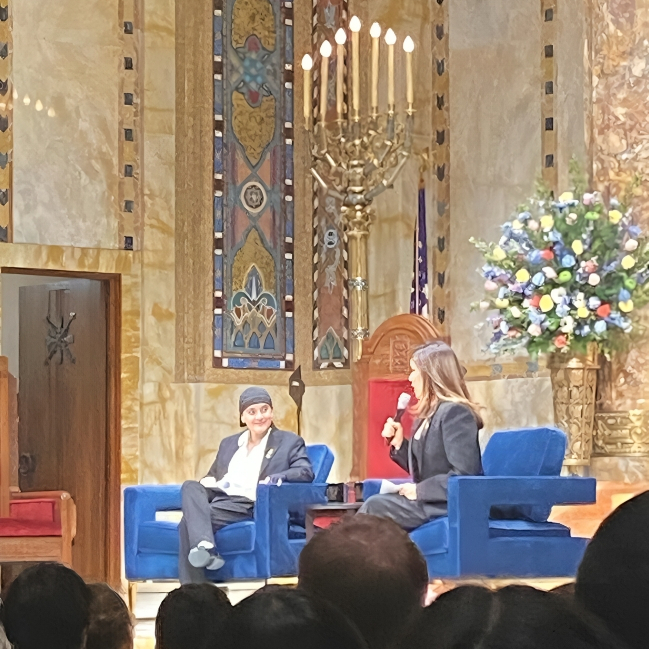
November 5th was quiet in this part of Queens. No one much wanted to talk about it, or even, talk. But that evening, Eric and I experienced the greatest show of Jewish resilience at Temple Emanu-El where journalist and personalit, Noa Tishby conducted the first American interview with October 7th survivor and former hostage Emily Damari. We expected a somber gathering, but what we saw was a celebration of Jewish pride, even chutzpadik, and a people unwilling to give in to despair. A sold-out crowd proudly flew our Israeli flags as we gave a rousing standing ovation for the bravery and heroism of Emily Damari.
Emily recounted her harrowing ordeal of nearly 500 days in captivity in Gaza, while somehow managing to find space for humor, sweetness, and defiance. Here are 10 reflections from this impactful evening with Emily Damari:
- She kept her wits about her — and it saved her life. On October 7th, after witnessing the senseless and brutal murder of her own dog, Emily Damari was shot in the hand and leg and violently kidnapped from the Kfar Aza kibbutz along with her best friends. Growing up just a stone’s throw from Gaza, Emily knew her enemy and understood immediately that she was being taken as a hostage. Her captors said “we’re taking you to hospital,” but she knew well she wasn’t going to Ashkelon. Even in the chaos of abduction, Emily was calling out information to her best friends, all of them hooded, saying things like “we’re in the same building, I’m going up the stairs!” Despite the horrors Emily endured, she was smart. As a lesbian, Emily understood the zero-tolerance policy for gays in Gaza. She was able to conceal her identity by inventing an elaborate backstory for why she was unmarried at age 26, comedically monologue-ing about overbearing brothers who didn’t approve of any boys she brought home. Emily also made a point of making herself appear as disgusting as possible to her captors for her own safety, refusing to shave her legs (not that she was granted showers).
- Defiance is at the core of our identity as Jews. On October 7th, Emily’s first stop was the infamous Al-Shifa hospital. Instead of bright-eyed hospital volunteers, she was greeted by over a dozen armed terrorists at this civilian hospital. Emily was seen by a doctor who identified himself as “Dr. Hamas” and was immediately taken into surgery. When she came out of surgery, Dr. Hamas informed Emily that they were not able to save her fingers that had sustained bullet damage. Emily’s response: “Sababa” (“awesome” or “cool”). She recounts thinking “like I’m supposed to care about my fingers, I’m a hostage in Gaza!” Today, Emily’s famous three-fingered salute has become a symbol for Jewish defiance everywhere.
- We felt helpless, but the support from Am Israel kept us going. From time to time, Emily and the other hostages were able to sneak a peek at a battery-powered TV. Emily was shocked to see her image on poster board. At one point, she saw her mother alive and well and protesting for Emily’s release. Before seeing this, Emily didn’t know if her mother was even alive. All week Emily and the other hostages would look forward to Shabbat when there would be televised protests in Hostages Square. Emily knew she was not forgotten and it mattered for her will to survive.
- She kept engaging her enemy in conversation. One theme that recurred again and again was Emily’s ability to talk to her captors. To be sure, it was daring and could have gotten her killed. But I prefer to see it as a reminder of her own humanity in the eyes of the captors. A power play, even. On one occasion, Emily recalled watching news coverage of the Columbia protests with her captor. As a gay woman herself (unbeknownst to him), she joked with him by pointing out how many of the protestors were gay. She asked him if he would kill them if they came to Gaza and he smiled and nodded. Then she asked him what he would do if it were discovered that his own brother was gay, someone he loved more than anyone in the world. His answer: he would still kill him.
- Hashem was with her in her suffering. Emily was constantly on the move from civilian locations above ground to below. Emily did not share many graphic details about her time in the tunnels, except to say that she felt G-d’s presence firmly, even in the most torturous times. She described hearing G-d’s voice, telling her she was chosen for a reason. May Emily’s unwavering faith be a great comfort to us all in times of fear.
- Simply being with others made all the difference. It’s hard to see the positive in this horrific situation, but Emily expressed gratitude that at least she was never held in solitary captivity. Emily was held with several other young women and they looked out for each other, helping one another to sleep at night. It’s a stark reminder that being witness to each other’s pain brings comfort even in the very worst of times.
- There were some lighthearted moments. When the girls learned that they were going to be released, for real this time, they “pampered” each other for their big day, doing each other’s hair and shaving legs. Emily said “don’t you want to look pretty for your release day?!”
- Freedom is incomplete until every Jew is free. Emily recalled how hard it was to adjust out of her life in captivity, knowing that her best friends from Kfar Aza were still going through hell. She couldn’t feel joy in her relationships or move forward. When her best friends were finally released, Emily explained she felt more joy than on her own release day. This underscores what we already feel in our gut: Am Israel is a family, deeply connected by our harrowing history and generational trauma.
- Take joy in simplicity. For Emily, life on the other side of this is filled with gratitude. Things she appreciates? The toilet that flushes. Seeing the sun. There are so many unnoticed luxuries of our lives that we have the privilege of taking for granted. I’d like to invite us to note the simple blessings throughout our day, as we do in our morning prayers.
- Don’t let the terrorists win. It has become a cliché, but if Emily can hold her head up in Gaza, then so can we. The truth is, I see many of the same characteristics in Emily as I did in my grandfather Herschel, who survived the Holocaust. He never lost his sense of humor or moral compass. He rarely complained and loved living until his dying day — at age 99. This daring sense of resolve is chicken soup for the Jewish soul.
When the evening at Temple Emanu-El concluded, Eric and I looked at each other and wondered if it would be appropriate to have a date night after something like this. Of course! We should never be misled into taking for granted the biggest gift we have: being alive. Sababa.
Rachel Black serves as Cantor at Hillcrest Jewish Center, Queens, NY