‘Unwitting’ Jewish Heroine Blew The Whistle On Argentine Prostitution Ring
The Zwi Migdal organization spread from Argentina to Canada, the U.S., Europe and even China, keeping girls and women in sexual bondage until a brave woman and an honest cop broke it.
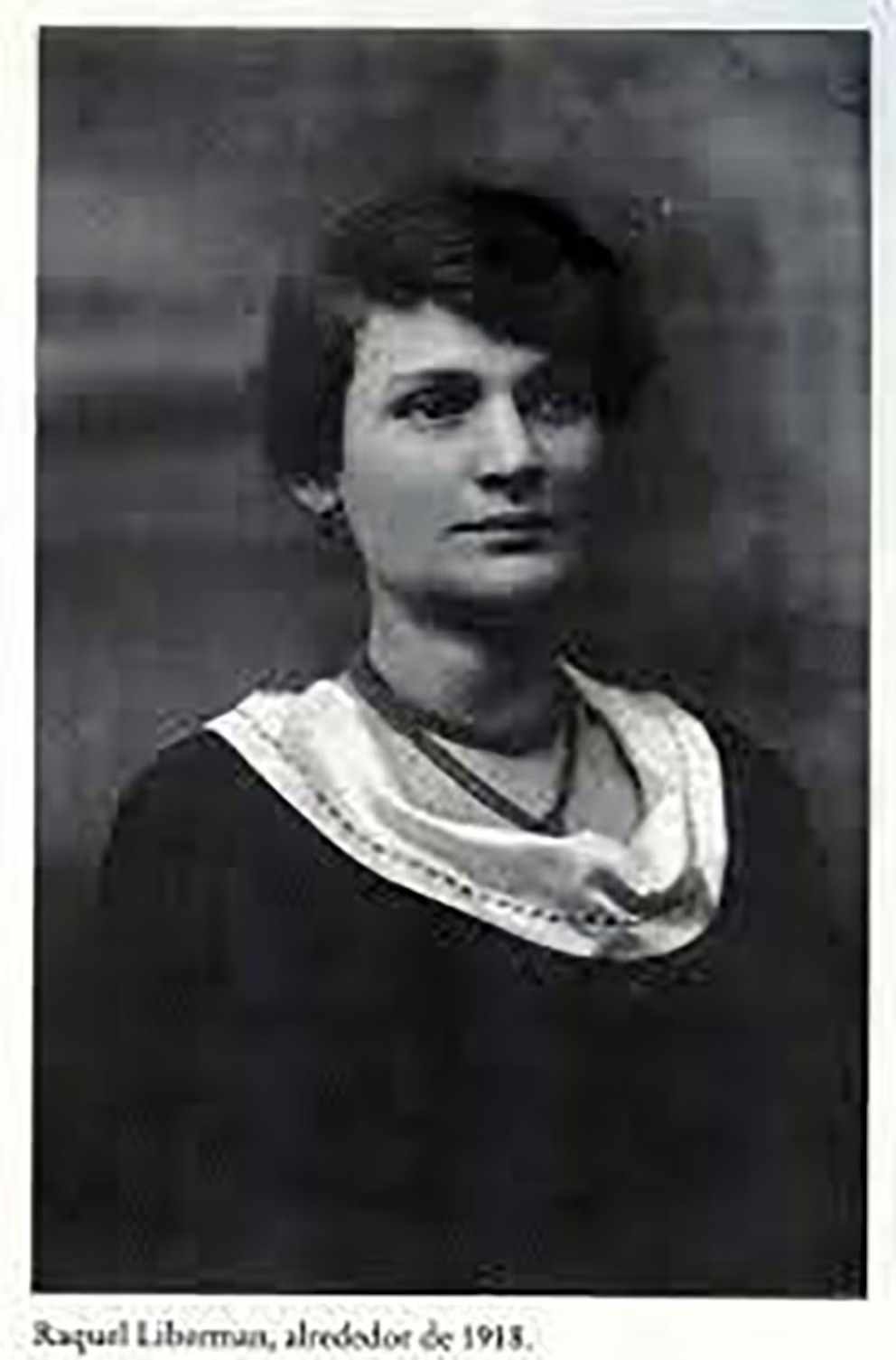
After enduring more than a decade of captivity, a 29-year-old Polish Jewish woman, Raquel Liberman, managed to escape the Zwi Migdal prostitution ring in Buenos Aires on the last day of 1929. Her flight marked the beginning of the end for the powerful Jewish criminal organization, which raked in more than $50 million a year under the protection of Argentine authorities. It took the courage of one woman—along with an honest policeman and a sober judge—to challenge entrenched power and free hundreds of women from sexual slavery.
The opening lines of a poem, ‘Milonga for a women’, composed by Humberto Constatini, recount Liberman’s heroism: ‘No just anyone dared / according to what the old folks tell us / to confront the Migdal / back in the 1930s…/ And yet, there was one who / cross the line / she had been brought from Poland / and her name was Raquel.’ The young mother had deliberated for some time before acting, having been held in sexual slavery for ten years. According to Argentine police records, it was the afternoon of December 31, 1929, when she filed a formal charge at a Buenos Aires police station. Liberman chose carefully: it was the precinct where Officer Julio Alzogaray served, a man widely known for his probity.
Historians have reconstructed part of the exchange between the officer and the woman who dared to speak. Alzogaray asked, “Are you certain about what you are going to do?” She replied, “I’m certain. I can only die once.” Feeling dead inside and with nothing left to lose, Liberman hardly feared retaliation from the powerful Zwi Migdal criminal organization.
By the time Liberman appeared before Alzogaray, Zwi Migdal had branches in Brazil, Mexico, Canada, the United States, Poland, Moscow, Britain, Germany, and even China. Populated largely by Polish Jewish criminals, the organization was abetted by corrupt police, politicians, and judges who routinely looked the other way when trafficked women were involved. Spaniards, Italians, and local Argentines also operated trafficking rings, but Zwi Migdal had earned a reputation as the largest and most powerful network. Liberman understood that denouncing it would almost certainly place her life in danger. Nevertheless, her testimony marked the beginning of the end for an organization that had profited for decades from the bodies of trafficked girls and women.
The origins of the network date back to 1889, when the “Club of 40” was formed—a group of pimps who banded together to support one another, exchange information, and devise strategies for evading authorities. In 1906, Noah Trauman legally registered the so-called Warsaw Israeli Mutual Aid Society in Argentina, concealing its criminal activities beneath the veneer of charity. The organization gained social respectability among those unaware of its true nature. Its agents scoured Eastern Europe for girls between the ages of 13 and 16, deceiving them with promises of marriage or employment in the burgeoning South American republic. Once aboard ships bound for Argentina, the girls were raped and kept in cages until arrival. There they were disembarked and “auctioned off” among Zwi Migdal partners in so-called “parades” held at the Café Parisien at 3184 Alvear Avenue—owned by Salomón Mittelstein and Achiel Mostowsky—and at the Hotel Palestina in Buenos Aires.
An honest cop
Journalist Gustavo Germán González—then a young police reporter for the daily Crítica—managed to witness one of these parades. “The women, sometimes brought there with false promises of marriage, were exhibited naked and sold to the highest bidder,” he later wrote in a chronicle that caused a public sensation but prompted no official action.
In her book La Zwi Migdal – Para una memoria de la vergüenza argentina (Zwi Migdal – For a Memory of Argentine Shame), Elsa Drucaroff details the organization’s operations: "The Varsovia [Warsaw Israeli Mutual Aid Society] financed trips, supervised the sale of women, compensated associates who for some reason lost a slave, organized the transfer of girls from one brothel to another, imposed fines for breach of contract, lent money to set up brothels, managed their supplies and purchases of work materials (bedding, lingerie), provided judges to arbitrate conflicts that arose between pimps, and offered all the institutional support it could, given its excellent relations with those in power. In reality, this was the defining function of the mutual aid society: to manage and pay bribes to the police, the municipality, and the justice system; to rely on its institutional legality to clandestinely exercise the organized management of public relations with the entire male network of officials who were legal or clandestine partners in the exploitation of prostitution.”
By this time, Buenos Aires’ first red-light district had been established, bounded by Lavalle, Viamonte, Libertad, and Talcahuano streets. Zwi Migdal operated brothels on Junín and Lavalle streets, with names such as ‘El Chorizo’ [The Sausage], ‘Las Esclavas’ [The Female Slaves], ‘Gato Negro’ [Black Cat], ‘Marita,’ and ‘Las Perras’ [The Bitches]. Enslaved women worked daily from 4:00 p.m. to 4:00 a.m. and were expected to service a minimum of 600 clients each week.
The death of a husband
Unlike many of her companions in the sex trade, Raquel Liberman had not been lured to Buenos Aires under false pretenses. She came to reunite with her husband—only to be widowed shortly after her arrival. Born Rokhl Lea Liberman on July 10, 1900, in Berdichev—then Poland, now Ukraine—she grew up in extreme poverty. Her husband, Jaacov, whom she married very young and with whom she had two children, shared the same fate. Seeking escape, he emigrated to Argentina in 1921, promising to send for his family once established. He was assisted by his sister Elke, who had arrived in Argentina in 1910 as part of the Zwi Migdal trafficking network and had risen to become the “madam” of a brothel in the rural town of Tapalqué.
Upon arrival, Rokhl Spanishized her name to Raquel, hopeful for a new beginning. Instead, Jaacov’s death in 1923 left her alone and destitute. The only assistance offered by her sister-in-law was childcare—so that Raquel could prostitute herself in Zwi Migdal’s brothels in the capital.
With no other options, Raquel entered the sex trade. She was moved from house to house and secretly hoarded money in hopes of escape. After six years, she managed to buy her freedom, open a shop, and dream of reuniting with her children. That hope was crushed when she accepted the courtship of a man who deceived her and delivered her back into the trafficking network. She was confined for months, never allowed onto the street. During the New Year celebrations, perhaps aided by her guards’ distraction, she escaped and went directly to police chief Julio Alzogaray. Her complaint, still preserved in police archives, is dated December 31, 1929.
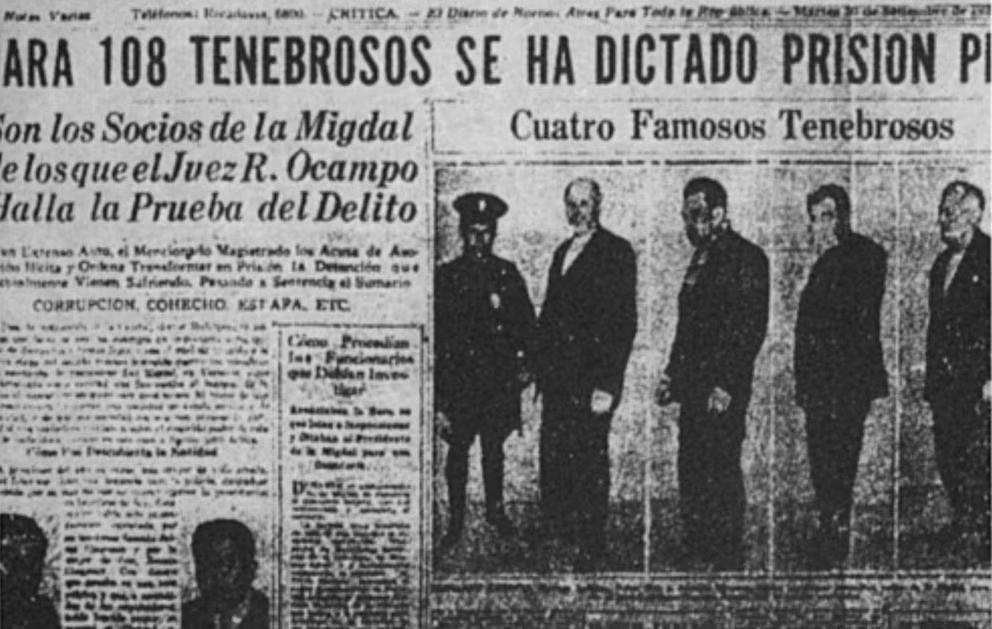
Impressed by her resolve, Alzogaray brought Liberman in early January 1930 before Judge Manuel Rodríguez Ocampo, who launched an exhaustive investigation into Zwi Migdal and its operations in Buenos Aires. The pimps were caught off guard; until then, the justice system had largely ignored them. Their ties to Argentina’s establishment were so strong that they had escaped even the anti-Semitic violence of 1919. “None of the brothels were vandalized during the Tragic Week,” writes José Luis Scarsi in Los judíos impuros – Historia de la Zwi Migdal (The Impure Jews – History of Zwi Migdal). He adds that although Argentina’s 1902 “Residence Law” allowed for the expulsion of foreigners, “It was implemented especially upon anarchists, but not with pimps; at most, some were deported to Uruguay, from where they could continue to run their businesses.”
Nevertheless, neither Rodríguez Ocampo nor Alzogaray was intimidated. Because prostitution itself was legal, Alzogaray pursued charges of “unlawful association.” Rodríguez Ocampo ruled that the charge had been proven and issued arrest warrants for approximately 400 individuals. Police arrested 108 members and sought another 300, many of whom escaped after being tipped off.
Although segments of Argentine society and the media blamed “the Jewish community,” the investigation exposed a broader conspiracy violating “public morality,” involving police chiefs, politicians, and businessmen. When the case reached the Court of Appeals, judges exploited procedural technicalities to overturn the charge and release all but three detainees.
Liberman stood virtually alone. None of her fellow victims joined her complaint; some even accused her of lying. Still, her courage initiated the dismantling of illegal prostitution in Argentina. The effect proved temporary, as the practice resurged during the politically unstable “infamous decade” that followed the 1930 coup d’état.
Liberman—whom Scarsi called the “unwitting heroine”—died on April 7, 1935, at age 34, at Argerich Hospital, where she was being treated for terminal thyroid cancer. She left behind two orphaned children, aged 14 and 15. For years, the location of her remains was unknown. A later investigation revealed that her sister-in-law Elke—the same woman who had introduced her to prostitution—buried her under her married name, Rujel Lea L. de Ferber, in a cemetery in Villa Domínico, in the Avellaneda district of Buenos Aires. In that same cemetery lie many of Zwi Migdal’s pimps.
By confronting a violent criminal empire, Raquel Liberman embodied the heroism of her ancestors in faith. In the deuterocanonical Book of Judith—preserved in the Septuagint and in the Catholic, Eastern Orthodox, Oriental Orthodox, and Church of the East Old Testament, though excluded from the Hebrew canon—the Jewish widow Judith saves her people by beheading the Assyrian general Holofernes. Likewise, Raquel Liberman liberated her sisters from slavery and restored honor to a community tarnished by the crimes of some of its own members.