Without Indigenous Allies Cortes' Conquest Of Mexico Was Impossible
Tlaxcaltecans realized that a strategic alliance with the Europeans was in their interest.
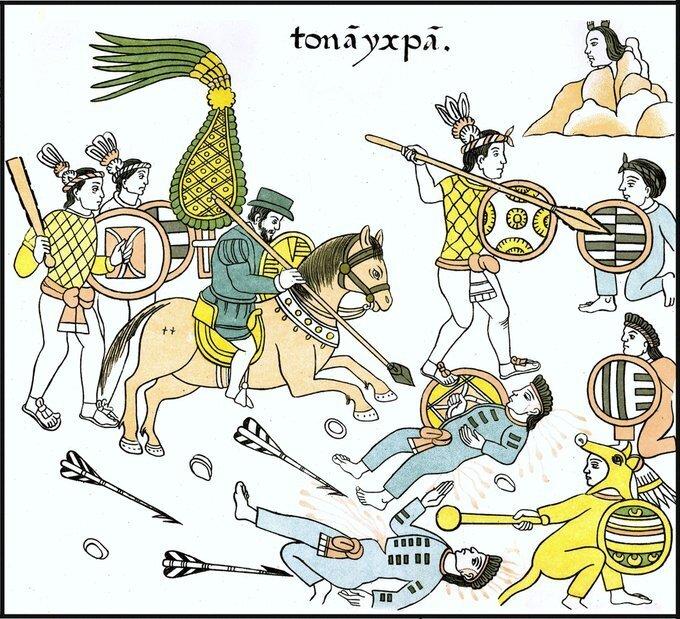
The beginnings of the alliance between the Tlaxcaltecs of Central Mexico and the Spanish to end the Mexica or Aztec tyranny were not peaceful. They were the result of an open, fierce and prolonged war, in which both sides fought to the limit of their strength.
When Hernán Cortés and his troops entered the territory of Tlaxcala in 1519 near the Mexica city of Tenochtitlan, they did so as declared enemies and commanded some 400 Spanish infantrymen, between 15 and 16 horses, a few light cannons, and several thousand Totonac indigenous allies. Opposing them was a warrior confederation capable of mobilising tens of thousands of combatants. The Tlaxcaltecs saw these foreigners as a threat and, at the same time, as valuable prey for their sacrificial altars. For days, battles raged in the open countryside, with constant and relentless attacks, in which the Spanish were on the verge of annihilation.
The indigenous numerical superiority was overwhelming. The Tlaxcaltecan armies outnumbered Cortés' forces several times over, and yet the Spanish resisted by forming compact blocks, protecting each other, and sustaining continuous combat until exhaustion. The loss of most of their horses left the Spanish on the verge of collapse. There was not a day without casualties, nor a night without the certainty that the next day could be their last.
However, the Spaniards' unexpected resistance had a decisive effect. The Tlaxcaltecs realised that they were not facing a common enemy, but extraordinarily tenacious warriors, capable of surviving against all military logic. At the same time, Cortés repeatedly made a clear and constant offer: to cease hostilities and join forces against the true common enemy, the Mexica Empire of Tenochtitlan, which for decades had suffocated Tlaxcala through ritual wars, tributes and economic isolation. The Tlaxcaltecans had long been forced to provide sacrificial victims for the altars of Tenochtitlan.
The final decision was not the result of fear, but of political calculation. After the bloodiest battle, the principal Tlaxcalan lords deliberated, and the vision of Xicoténcatl the Elder prevailed, who understood that continuing the war would only lead to useless bloodshed. Allying with the Spanish offered a unique opportunity to break the Mexica rule and irreversibly alter the balance of power in central Mesoamerica.
Without Tlaxcala, the fall of the Mexica Empire would have been simply impossible.
(The image corresponds to the Lienzo de Tlaxcala, an indigenous pictographic document produced in the mid-16th century by the Tlaxcaltecs to record their alliance with the Spanish during the conquest of Mexico.)