New Study Suggests Neanderthal Humans Have Something To Teach About AI
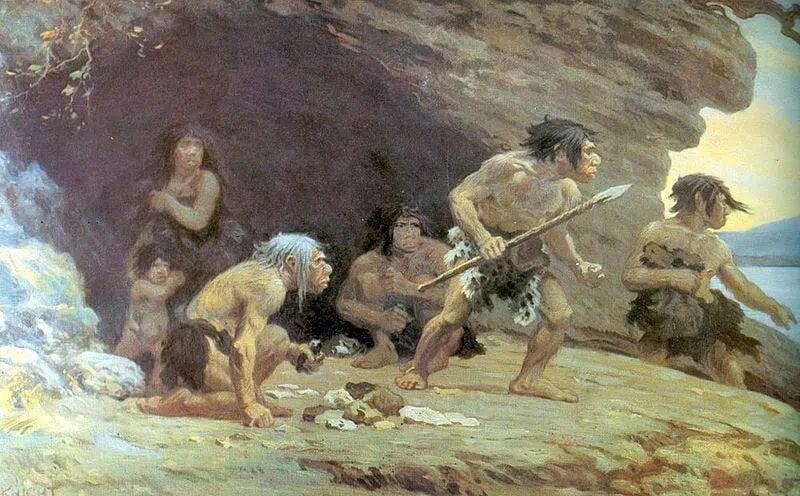
Imagery of Neanderthals dating to the 1800s skews the modern perception of the early humans' physical appearance and culture, which is exacerbated by AI image generation.
Phones, laptops, tablets, smart watches — they’re a part of everyday life, simplifying access to entertainment, information and each other. Ongoing advancements in generative artificial intelligence are giving these technologies even more of an edge. Whether someone asks their device where dinosaurs lived or how accelerated their pulse is, AI can get the information quicker than technology has ever been able to do. Accuracy, on the other hand, is still in question.
Generative AI has the power to influence how the past is represented and visualized. Researchers across the country are exploring this phenomenon, including the University of Maine’s Matthew Magnani. Magnani, assistant professor of anthropology, worked with Jon Clindaniel, a professor at the University of Chicago who specializes in computational anthropology, to create a model grounded in centuries of scientific theory and scholarly research. They asked two chatbots to create images and narratives depicting daily life of Neanderthals and published their findings in the journal Advances in Archaeological Practice.
They found that accuracy rests on AI’s ability to access source information. In this instance, the images and narratives referenced outdated research.
Magnani and Clindaniel tested four different prompts 100 times each, using DALL-E 3 for image generation and ChatGPT API (GPT-3.5) for narrative generation. Two prompts didn’t request scientific accuracy, while the other two did. Two were also more detailed, including context such as what the Neanderthals should be doing or wearing. Their goal was to understand how biases and misinformation about the past are present in normal, daily use of AI. “It’s broadly important to examine the types of biases baked into our everyday use of these technologies,” Magnani said. “It’s consequential to understand how the quick answers we receive relate to state-of-the-art and contemporary scientific knowledge. Are we prone to receive dated answers when we seek information from chatbots, and in which fields?”
Magnani and Clindaniel started the study in 2023. In just two years, GenAI has moved from the horizon of technological advancement to the forefront of modern society. If this study were repeated now, Magnani said he hopes chatbots would better incorporate recent scientific research. “Our study provides a template for other researchers to examine the distance between scholarship and content generated using artificial intelligence,” Magnani said. Clindaniel added that AI can be a great tool for processing large pools of information and finding patterns, but it needs to be engaged with skill and attention to ensure it’s grounded in the scientific record.
The abstract of the article reads:
"Artificial intelligence is reshaping the contemporary world. Trickling deeper into archaeology and history, these technological changes will influence how the past is written about and visualised. Through the evaluation of text and images generated using AI, this article considers the systemic biases present in reconstructed archaeological scenes. We draw on advances in computer science, running large-scale computational analyses to evaluate patterns in content. We present a case study examining Neanderthal behaviour, juxtaposing published archaeological knowledge with images and text made using AI. Our study reveals a low correspondence between scientific literature and artificially intelligent material, which reflects dated knowledge and cultural anachronisms. Used to identify patterns in (mis)representations of the past, the methodology can be applied to understand the distance between scholarly knowledge and any domain of content generated using AI, across any archaeological time depth and beyond the discipline."
What did GenAI get wrong?
The skeletal remains of Neanderthals were first depicted in 1864. Since then, the scientific community has shifted and conflicted over details surrounding the species, from how their clothes fit to how they hunted. This lack of concrete understanding and knowledge about Neanderthals is what made them an ideal topic to test the accuracy and sourcing ability of GenAI. The images generated during this study depicted Neanderthals as they were believed to look over 100 years ago: a primitive human-related species with archaic features more similar to chimpanzees than humans. In addition to large quantities of body hair and stooped upper bodies, the images also lacked women and children.
The narratives underplayed the variability and sophistication of Neanderthal culture as is understood in contemporary scientific literature. About half of all narration generated by ChatGPT didn’t align with scholarly knowledge, rising to over 80% for one of the prompts. In both the images and narratives, references to technology — basketry, thatched roofs and ladders, glass and metal — were too advanced for the time period.
Magnani and Clindaniel were able to identify from what sources the chatbots were compiling information by cross referencing the images and narratives with different eras of scientific literature. They found that ChatGPT produced content most consistent with the 1960s and DALL-E 3 the late 1980s and early 90s. “One important way we can render more accurate AI output is to work on ensuring anthropological datasets and scholarly articles are AI-accessible,” Clindaniel said.
Copyright laws established in the 1920s limited access to scholarly research until open access began in the early 2000s. Moving forward, policies surrounding access to scholarly research will directly influence AI generation and, in turn, the way in which the past is imagined. “Teaching our students to approach generative AI cautiously will yield a more technically literate and critical society,” Magnani said. This study is one of a series in which Magnani and Clindaniel are exploring the use of AI in archeological research and topics.