U.S. Stands Alone Opposing UN Gender Language in Women’s Commission Vote
UN Commission on Women can’t define what a woman is.
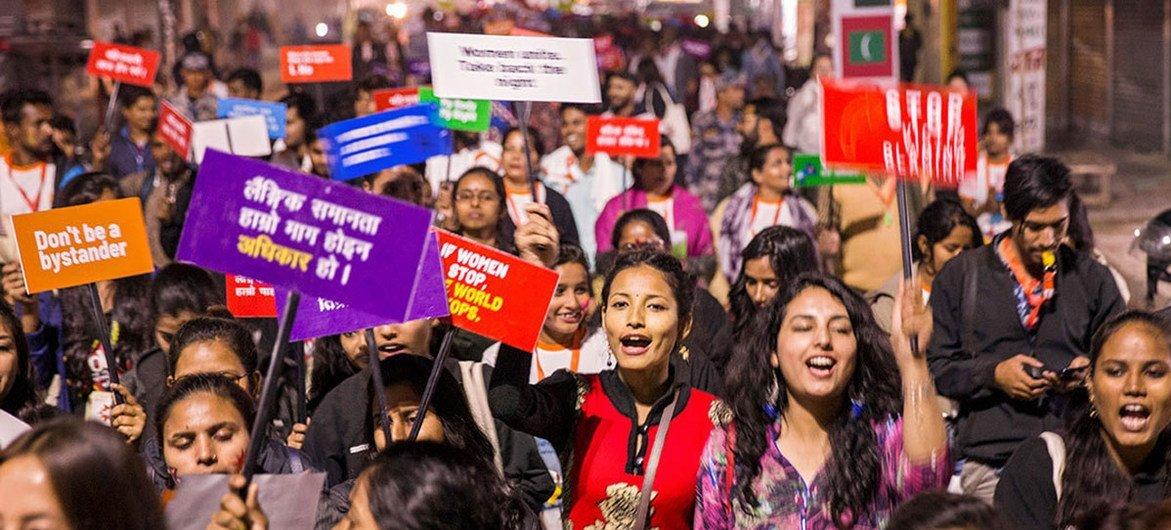
President Trump’s delegation expressed disappointment after the 70th annual United Nations Commission on the Status of Women (CSW) declined to define what a woman is, adopting instead a document that promotes gender ideology as well as diversity, equity, and inclusion.
Until now, the commission’s “Agreed Conclusions” had been adopted by consensus at the outset of the annual meeting, highlighting sharp differences with the European Union (EU) and allied nations over the meaning of “woman” and “gender.”
In an unprecedented move, the U.S. delegation called for a vote among the 45 participating countries on the final agreement, a document expected to influence UN policies, programs, and international law. The Trump administration’s amendments were defeated without debate. The United States stood alone in opposition to the Agreed Conclusions, while Côte d’Ivoire, the Democratic Republic of Congo, Egypt, Mali, Mauritania, and Saudi Arabia abstained on March 9. All other participating nations voted in favor.
Daniela Garcia of CitizenGo, an international prolife group, told EWTN News that the recorded vote essentially broke the worldwide consensus on gender.
On March 19, the last day of the CSW 70th Session, the U.S. offered a resolution titled “Protection of Women and Girls through Appropriate Terminology,” which would have affirmed “gender” as biological sex. Only the U.S., Chile, and Pakistan voted in favor, while there were 22 abstentions. However, the majority voted to table it, thus retaining the expansive definition of what a woman is.
Although the resulting Agreed Conclusions are not binding on the individual countries, they guide UN operations and funding priorities, including abortion, contraception, and transgenderism initiatives. Garcia said this remains “very dangerous, because these are dictates for where the money goes to UN agencies to promote abortion and contraception.”
Closing this 70th Session of the CSW, Sima Bahous of UN Women said, “Gender equality and women’s rights are the foundation on which our peace, security, economic prosperity, and sustainable development ambitions rely.”
Rebecca Oas, director of research at the Center for Family and Human Rights (C-FAM), told EWTN News that “the significance of the U.S. asking for a recorded vote is that for the first time, the outcome of CSW was not adopted by consensus in 70 years.”
In previous years, she noted, draft texts of the Agreed Conclusions were withdrawn when consensus could not be reached. Oas said that for this year, “The outcome has less normative weight than previous agreed conclusions, and it is generally seen as evidence of the deep and growing divide on issues of gender and sexuality that exists at the UN.”
The International Planned Parenthood Federation, Amnesty International, and Fos Feminista were among the groups that endorsed the Agreed Conclusions. Leftist and LGBTQ organizations, such as: the Global Trade Unions Caucus; the Lesbian, Bisexual, Trans and Intersex Caucus; Womens Rights Caucus; and the Young Feminist Caucus also supported the Agreed Conclusions.
The 70th session of the CSW, a key UN body, opened March 9 in New York and ran until March 19, bringing together member states from across the globe, including China, the U.S., and nations from Africa, Asia, and South America.
The Agreed Conclusions do not refer to motherhood or experiences unique to women and girls, but include ambiguous language on “universal access to sexual and reproductive health and reproductive rights,” widely understood to include abortion and contraception. In contrast, the Trump administration, according to a 2025 executive order, has sought to define women based on biological sex, while opposing transgender medical interventions, DEI initiatives in education, and policies allowing biological males in female-designated spaces.
Stefano Gennarini of the Center for Family and Human Rights (C-FAM), a UN-accredited organization, told EWTN News that the European Union used procedural tactics to block U.S. efforts to define “woman” and exclude abortion language from the document.
U.S. Ambassador Dan Negrea said, “The United States cannot in any way consider the document presently submitted to the commission as if it were agreed conclusions.” He criticized what he called “ambiguous language promoting gender ideology,” adding that undefined references to “sexual and reproductive health” imply abortion.
“How do we entrust the women and girls of the world to an agency that denies the biological realities of a woman?” Negrea asked. “The U.S. proposed that “gender” be understood solely as referring to men and women based on biological sex, rather than subjective gender identity.
In a formal statement, the U.S. delegation said, “It is the policy of the United States to use clear and accurate language that recognizes women are biologically female and men are biologically male. It is important to acknowledge the biological reality of sex to support the needs and perspectives of women and girls. We are disappointed the Political Declaration did not focus on the needs and perspectives of women and girls through precise terminology.”
“The Commission on the Status of Women is where the fight against gender ideology will be won or lost,” Gennarini said. “It’s not enough for one country to ban transgender ideology, or gender transition for minors, or protect women’s sports, because the Democrats can revert everything. The UN is exporting these policies wherever it has a favorable opportunity. Gender ideology can never be defeated unless it is defeated internationally at the UN and the Commission on the Status of Women.”
He added, “The more attention paid to the Commission by journalists, activists, and organizations, the better it is because when it comes to political accountability in the long run, we win because most of the world is conservative. What the Europeans and America’s Democrats are banking on is that nobody will pay attention to the UN, which they have used for the craziest, leftist policies on gender and abortion.”
While the UN did not originate the concept of “gender,” it played a major role in formalizing and globalizing its use, particularly since the 1995 Fourth World Conference on Women in Beijing. At that time, the UN stated that “gender” should be understood in its “ordinary, generally accepted usage.” The U.S. amendments this year sought to return to that definition, rather than one based on social or subjective identity.
Grace Melton, who studies international social policy at the Heritage Foundation, told EWTN News, “The left and UN bureaucracy play this game where, when it’s convenient to talk about women, they talk about women, but when they broaden the definition to include anyone who identifies as a woman, then they shift to talking about gender or gender identity. We’ve seen this in the U.S., and that’s what’s happening at the UN.”
She continued, “We’ve seen concrete examples in what happens to women’s private spaces. When access is based on gender identity, men and boys can enter women’s locker rooms, bathrooms, and domestic abuse shelters.”
Melton added that the UN, once a forum for addressing global challenges, is now “promoting something that, from my perspective and that of many others, is real evil.” She noted that courts in the United States and elsewhere sometimes cite UN positions in legal decisions, including an amicus brief filed by UN-affiliated experts in 2021 supporting abortion in Dobbs v. Jackson Women’s Health Organization.
Rebecca Oas told EWTN that some countries were pressured by the EU, which funds global programs related to abortion, contraception, and development. Advocacy groups supporting transgender ideology, she noted, publicly welcomed the document, saying they “see themselves” reflected in it.
“The feminists insist that the next UN Secretary-General be a woman, although how they define ‘woman’ might be open to interpretation,” Oas said. She added that while renaming the body a “Commission on Gender” would likely be resisted, proponents instead favor language such as “women in all their diversity,” broad enough to include biological men who identify as women. Still, she noted, the UN as a whole has historically defined women according to their commonly understood meaning, which aligns with the U.S. position.
Melton acknowledged that U.S. policies face an uphill battle, but said the break from consensus is significant. “The UN usually operates by consensus, and that has now been broken. The presence of serious disagreement undermines any claim of universal agreement,” Oas said, She added, “Even if they win this vote, they have ultimately lost the issue.”
Anna Derbyshire of CitizenGo told EWTN News that while the conclusions are supposedly non-binding, "The things coming out of the UN come into universities, places where policy is made, and therefore it hits U.S. school systems faster than anything else in the country."
Derbyshire added that throughout the now-concluded session, the CSW considered that so-called “transgender women are defined as women, even when the rights of biological women are at stake," and warned that Americans are not immune from UN decisions because “globalists in our government adhere to transgenderism in our schools, which is the greatest danger to the U.S.”