Euthanasia Case in Spain Draws Global Attention
As courts uphold a young woman’s request, the Church reiterates its call to accompany the suffering and uphold the sanctity of life. The government gives a green light for her murder, but not psychological help.
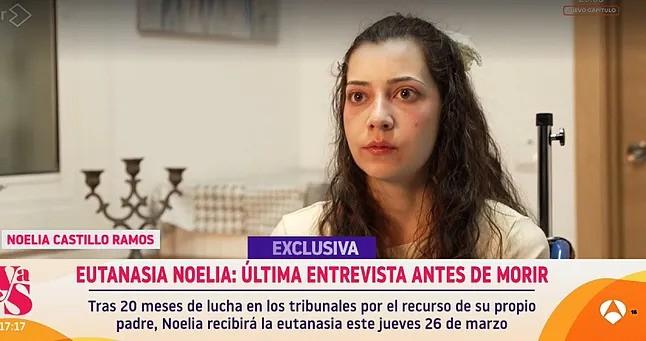
The case of Noelia Castillo Ramos, a 25-year-old woman from Barcelona, Spain, has drawn national and international attention following a prolonged legal and personal struggle over her request for euthanasia, scheduled for March 26 this year. To date, no Spanish bishop has issued a public statement specifically addressing her case.
Noelia Castillo Ramos was born into a deeply troubled family environment marked by psychological difficulties and substance abuse. As a result, she spent much of her childhood and adolescence in state care. In 2022, while living in a government center for juveniles, she suffered a gang rape. The identity and nationality of her rapists has been reserved by authorities because they were minors. Spanish law provides for the anonymity of minors accused of crime. Large numbers of illegal immigrant males, many of whom come from Muslim countries, are housed at government-operated shelters. Shortly after the brutal rape, on October 4, 2022, she tried to take her own life by jumping from the fifth floor of a building. While she survived, she sustained a severe and irreversible spinal cord injury, resulting in severe paraplegia. She is unable to move from the waist down, relies on a wheelchair, and has been assessed with a high degree of disability. Since the incident, she has suffered chronic neuropathic pain, sensory impairment, incontinence, and a high level of dependence in daily life.
During her rehabilitation at the Guttmann Institute in Spain, which treats neurological conditions, Noelia began expressing a persistent desire to end her life. Medical records noted her repeated statements that she did not wish to continue living and her intention to seek euthanasia. She has maintained this position consistently. Noelia suffers from persistent pain and depression, which was diagnosed even before her suicide attempt. However, she has not received any psychological counseling or psychiatric treatment, according to Abogados Cristianos.
On April 10, 2024, Noelia formally requested euthanasia before the Catalonia Guarantee and Evaluation Commission (CGAC), as permitted under Spain’s 2021 euthanasia law. On July 18, 2024, the Commission approved her request. Her father, supported by the nonprofit Abogados Cristianos law firm, challenged the decision, arguing that she lacked the capacity to make such a grave choice. This initiated a series of legal proceedings that extended over more than two years. Spanish courts at multiple levels—including regional courts, the Supreme Court, and the Constitutional Court—ultimately upheld the authorization. They consistently found that Noelia was an adult with full decision-making capacity and that she met the legal criteria established under Spanish law.
After exhausting domestic remedies, the father appealed to the European Court of Human Rights, which rejected requests for interim measures to halt the procedure, while leaving open the possibility of reviewing the case in the future.
In an interview released this week, Noelia reaffirmed her decision, stating that she wished “to depart in peace and stop suffering.” She acknowledged that her family opposes her decision, though her mother has said she respects it. She is scheduled for medically-assisted death on March 26 at 6 p.m. local time. She told an interviewer that she has chosen the makeup and dress she will wear for the procedure, saying, "I want to look cute."
Santiago Abascal, the leader of Spain's opposition VOX party, tweeted on March 25: " I am deeply shocked by this news. The state takes a daughter away from her parents. The Menas [Unaccompanied Foreign Minors] rape her. And the solution the state offers is to kill her. Sánchez’s Spain is a horror film." Prime Minister Pedro Sanchez is the leader of the leftist coalition government of Spain. Yolanda Ramos, Noelia's mother, said in response that she turned over Noelia to government care because she lacked the means to support her.
Catholic Teaching on End-of-Life Care
While the Church accompanies all who suffer with compassion, Catholic teaching consistently affirms that euthanasia—understood as an act or omission intended to cause death in order to eliminate suffering—is morally unacceptable. The Catholic Church teaches that every human life possesses inherent dignity from conception until natural death. As stated in the Catechism, euthanasia constitutes “a grave violation of the law of God,” regardless of the intentions or circumstances. At the same time, the Church makes an important distinction between euthanasia and the legitimate refusal of “overly burdensome” or disproportionate medical treatment. Patients may decline extraordinary means that offer little hope of benefit or impose excessive suffering. However, this is not the same as intentionally causing death.
In documents such as Evangelium Vitae, Samaritanus Bonus, and the Catechism of the Catholic Church, the Church calls for a response rooted in care rather than hastened death.
This includes:
- The provision of palliative care to alleviate pain
- Psychological and spiritual accompaniment
- The presence of family, community, and the sacraments
- A commitment to uphold the dignity of the person, even in profound suffering
The Church also recognizes the heavy emotional, psychological, and physical burdens that can lead individuals to request euthanasia. Rather than condemning the person, Catholic teaching calls for compassion, solidarity, and renewed efforts to ensure that no one feels abandoned or without hope.
The case of Noelia Castillo Ramos highlights the profound human suffering that can accompany serious illness and trauma, as well as the complex legal frameworks that now exist in some countries.
For Catholics, it also raises enduring moral questions about suffering, dignity, and the meaning of care at the end of life. While the law may permit certain actions, the Church continues to propose a vision centered on the inviolability of human life and the duty to accompany the suffering with love, rather than to hasten death.