Priest Tells Catholic University Grads 'Endurance Vanquishes Mediocrity'
Msgr. Shea was refreshingly unsentimental in his advice to grads, saying that a great education does not solve what he called “the great mediocrity” of human life, but makes one more aware of it. Only one answer suffices: “Stability. Whatever you want to call it — constancy, perseverance, endurance, steadfastness, fidelity. Stability within and without.”
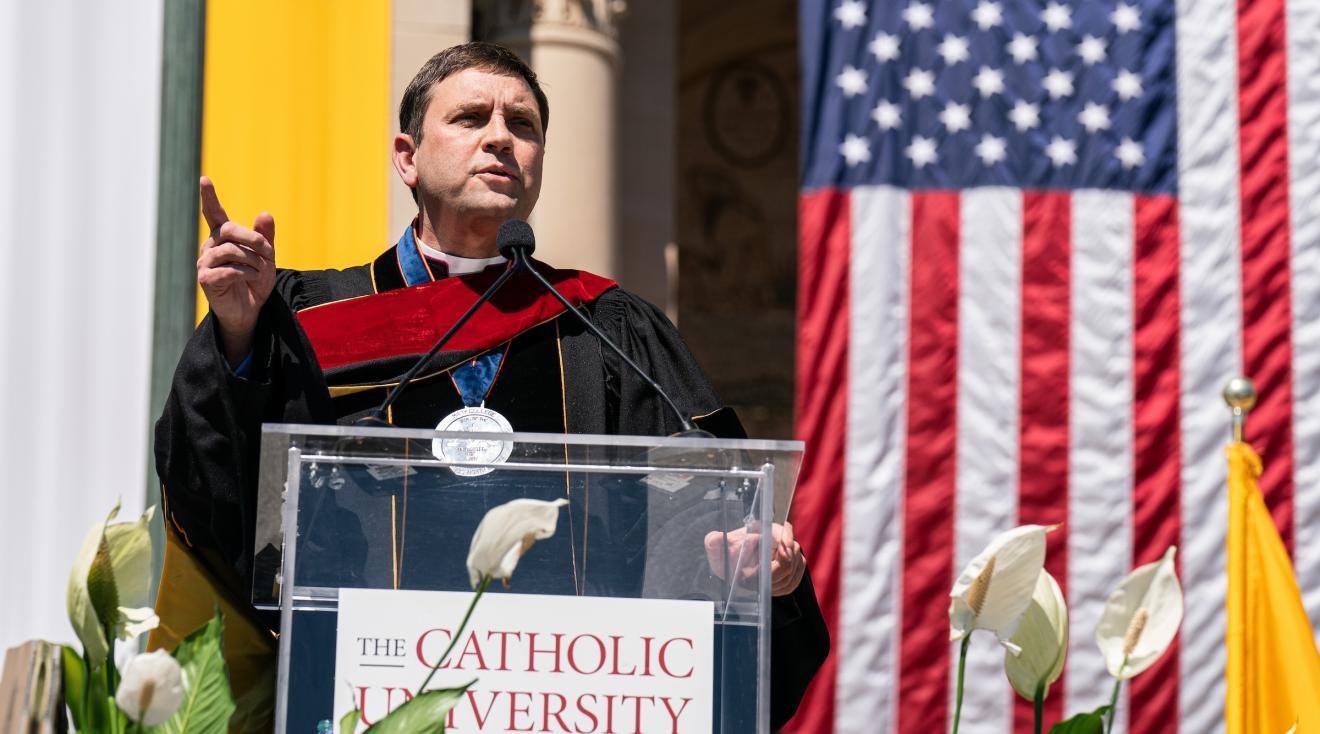
Msgr. James Shea. Credit: Catholic University of America.
Commencement addresses pop up across the country in the spring. Regretably, most are forgettable, as they are often filled with nostrums from successful business executives, plutocrats, and politicos. But at the Spring Commencement at Catholic University of America on May 16, an exception speech, or rather -- a homily -- was offered that was bracing, honest, and maybe even a little bit uncomfortable. Monsignor James Shea, an alumnus of that institution, gave remarks without a teleprompter or any obvious notes that were not only cerebral and pastoral, but also heartfelt. It was obvious that he was grateful to be a CUA graduate but also to be back on campus, which saw his formation as a scholar and priest. HJe credited CUA for offering an environment where scholars were formed in a community of faith. To the graduating class, he extolled the virtue of endurance, perhaps above all others, because it "vanquishes mediocrity." After all, he said, Jesus Christ asks his follows, "Remain in me, that you may bear fruit that will last."
Mediocrity should be the bane of every Catholic, Msgr. Shea emphasized when he recounted a story he heard during a visit to Dachau, where thousands of Jews and others were annihilated. He told the graduating class: "I was there with more than 60 of my health sciences faculty, and we were taken around, and our guide stopped for a moment at what was the place where once stood the priest block of Dachau. The Nazis had more than 3,000 clergy who were interred there as prisoners. More than 90% of them were Catholic priests. And she told us about how there was a secret ordination at Dachau. There was a seminarian who was dying of tuberculosis who was a prisoner, and a French bishop, also a prisoner, and he secretly ordained him a priest. She told us about how the priests were forced to build the crematoria of the camp so that people would believe that these hands are for death. And while she was telling it, while she was speaking about it, the bell sounded from the Chapel of the Mortal Agony of Christ, the 3:00 hour, the hour of divine mercy, and shivers shot down my spine.
"And so we made our way then afterward to the Carmel, the Carmelite monastery that stands on the grounds of the camp, where the sisters live lives of reparation for the atrocities that happened there. And just before we went in the door, the guide pulled me aside and she said, “Father, I want to tell you something. I have to tell you something. I was the translator for the last surviving priest of Dachau. He died last year at the age of 102. And I asked him at the end of his life, ‘What do you think of your life?’ And he said, ‘Well, I’m grateful, of course, but I’m also ashamed.’” And she said, “Ashamed? What could you possibly have to be ashamed about?” And he said, “Well, part of it’s just survivor’s guilt. I lived and my brothers died. But there’s this other thing. I was a mediocre priest, and it took Dachau to get the mediocrity out of my priesthood. I was a mediocre priest,” he told her. “It took Dachau to get the mediocrity out of my priesthood.”
"That haunted me for a long time. Indeed, the question of mediocrity, of human mediocrity, haunts every single examined life. We human beings are alone in the visible world as creatures who are ill at ease with our existence. Something is not right about us. We are not as we should be, and we know it. This is what John Paul II called the gap between who we were made to be and who we are."
At a time when mediocre minds, enflamed by hatred clamor and even revive the age-old hatred of Jews, the elder brothers of the faith, Msgr. Shea's words should embolden every Catholic, every Christian, and every Jew to rise up to the very best of their abilities. Go toward the light and life!
The transcript of his remarks follows below. A video and audio of the remarks can be seen here.
Your Eminence, your Excellency, President Peter Kilpatrick, trustees, all those who so valiantly serve the mission of The Catholic University of America, congratulations on this landmark commencement in the 250th anniversary of the founding of our nation. And thank God for your leadership.
To the teaching faculty of The Catholic University of America, for all that you have done, thank you. Look at you today, not in front of an early morning bleary-eyed classroom, but in your full splendor, basking in the sunshine of the gratitude of these graduates, which will only deepen and strengthen through the years. You look amazing. You’ve never looked better. And if there’s anything that I learned from my two degrees in philosophy at Catholic U, it’s that appearances are everything. You are very nearly the most impressive university faculty in the whole world. I can only think of one faculty that could even attempt to rival you, and I think that most of them would rather work for Peter than for me.
Catholic University President Peter Kilpatrick congratulates Msgr. James Shea on the latter's honorary doctorate.
Msgr James Shea receives honorary doctorate from President Peter Kilpatrick
To the parents and family of our graduates, you were with these graduates. You remember when they took their first steps, and now on stages across this campus, you will watch them cross the stage and walk into the epic adventure of their lives. If all we did for the rest of my speech was cheer for you, it would be woefully inadequate.
And to the class of 2026, my classmates, we did it. High five. You’ve worked so hard, late-night study sessions and tests and papers and comprehensive exams and dissertations, and me too, I flew here in Delta Comfort Plus. It’s like the religious pluralists say, “Many paths to the one mountaintop.” But I like St. Paul better, works and grace.
I came to The Catholic University of America in August of 1995, a farm kid from the middle of nowhere, in the last days before the internet became a daily part of human life. Not a day has passed since then when everything that was poured into me on this campus, in my experiences, in my study, in my friendships, has not affected the decisions that I make, the dreams that I dream, the prayers that I pray, the thoughts that I have, and my imagination. Catholic University–this university–made me who I am.
When I left here and went to Rome, my classmates at the Vatican’s North American College had a running joke that Jim Shea could not have a single conversation without mentioning The Catholic University of America. In fact, there’s a rumor that at one point it was made into a drinking game. And on my way out here, the TSA agent at the Bismarck Airport was a former high school student of mine. He said, “Monsignor, where are you going this time?” I said, “I’m going to Catholic U in Washington.” And without missing a beat, he said, “Oh, yeah, you used to talk about that place all the time.” Then he began to mimic me: “Never deny, seldom affirm, always distinguish. When you think, be sure to make strategic distinctions. Faith seeking understanding. Hear now the principles of Catholic social teaching.” But you know, everybody, I couldn’t help it. When I was in Rome and when I was a young teacher, I couldn’t help it. I was so proud to be from here. I was so glad and happy to be from here.
Still, this campus holds for me some of my happiest memories. I can see myself right behind you in Mullen Library, holed up deep in the stacks with piles of books all around me. Or walking into McMahon Hall on a sunny morning like today, standing up a little straighter under the gaze of the statue of Leo XIII. Sitting at the feet of Pritzl, Sokolowski, McCarthy, Hassing, Hittinger, White. Over there in the distance, I can still hear music and laughter coming from Colonel Brooks Tavern — now long gone. And somewhere between here and College Park is an adoration chapel, and I’m driving through the night with the father of one of your classmates graduating today. Two lonely-eyed boys in a ’91 Mercury Sable looking for God. Like most of my friends in those days, he was way more than I deserved, but very much what I needed.
John Senior has written that universities aren’t first of all places for research, but places for friendship, and boy, was this a place where we could all love each other. “What needs a man?” the philosopher asks. “What needs a man who has not virtue? That man needs a friend.” And you, too, fellow graduates, you have been equipped by this place in friendship and in study to confront in your life your great mediocrity.
And so, what I’d like to do in my time here today is, here at the end of all things, although remote enough from the slopes of Mount Doom, I would like to remind you of what you have learned, but which perhaps you didn’t notice. There is a thread that runs through education and friendship straight to the very heart of the greatness of the human soul.
Exactly 10 years ago, I was visiting Lourdes in France with yet another friend whom I had met here on this campus, and I experienced the Blessed Mother asking me to bring my health sciences faculty to Lourdes someday, such that they could see the way that medicine and science and faith are the best of friends in that place, and what happens when healing and hope are not just an idea but a person. But then I heard from her that not only should I do that, but before taking them to Lourdes, I should take them to Dachau in Germany, the first of the Nazis’ concentration camps, the place where they pioneered the medical experimentations, so that they could smell and see the culture of death, not just the culture of life. So that they could see and smell what happens when medicine turns against the sanctity of life.
And so a year later, I was there with more than 60 of my health sciences faculty, and we were taken around, and our guide stopped for a moment at what was the place where once stood the priest block of Dachau. The Nazis had more than 3,000 clergy who were interred there as prisoners. More than 90% of them were Catholic priests. And she told us about how there was a secret ordination at Dachau. There was a seminarian who was dying of tuberculosis who was a prisoner, and a French bishop, also a prisoner, and he secretly ordained him a priest. She told us about how the priests were forced to build the crematoria of the camp so that people would believe that these hands are for death. And while she was telling it, while she was speaking about it, the bell sounded from the Chapel of the Mortal Agony of Christ, the 3:00 hour, the hour of divine mercy, and shivers shot down my spine.
And so we made our way then afterward to the Carmel, the Carmelite monastery that stands on the grounds of the camp, where the sisters live lives of reparation for the atrocities that happened there. And just before we went in the door, the guide pulled me aside and she said, “Father, I want to tell you something. I have to tell you something. I was the translator for the last surviving priest of Dachau. He died last year at the age of 102. And I asked him at the end of his life, ‘What do you think of your life?’ And he said, ‘Well, I’m grateful, of course, but I’m also ashamed.’” And she said, “Ashamed? What could you possibly have to be ashamed about?” And he said, “Well, part of it’s just survivor’s guilt. I lived and my brothers died. But there’s this other thing. I was a mediocre priest, and it took Dachau to get the mediocrity out of my priesthood. I was a mediocre priest,” he told her. “It took Dachau to get the mediocrity out of my priesthood.”
That haunted me for a long time. Indeed, the question of mediocrity, of human mediocrity, haunts every single examined life. We human beings are alone in the visible world as creatures who are ill at ease with our existence. Something is not right about us. We are not as we should be, and we know it. This is what John Paul II called the gap between who we were made to be and who we are.
So what can we do to contend with the mediocrity of our lives? Well, talent doesn’t help. I wish it did, but it doesn’t help. Indeed, the most talented among us are very often the least impressive because they somehow think that, or take for granted that they don’t have to do the hard work that’s necessary for genuine human excellence. It’s Aesop. It’s the tortoise and the hare.
Deep learning also does not eliminate our mediocrity. Your professors in this alma mater of ours have given you one of life’s great gifts, the gift of a great education. Not just training for a job, but deep and rich and true education. But because you have that education, you know that you’ve only just made a start. You know that the vast mansion of wisdom is much greater on the inside than on the outside. It’s infinite in there, and that in your time here you’ve only just breached the threshold. Confronted with all the things to know and learn and savor and contemplate, your mediocrity is absolute in the face of that.
Also, wealth doesn’t help. It’s a funny thing. A man only needs so much to flourish in life, and if there’s much beyond that, unless he takes refuge in generosity, he becomes more and more ridiculous or worse. In our budgeting at the University of Mary, we have a saying, “If you want to diminish something, hold back its resources. But if you want to corrupt something, flood it with resources.” No, wealth is not the answer, and neither is honor. In fact, honor amplifies our experience of mediocrity. When all speak well of you, unless you’re a nutcase, you think, “What would they say if they knew who I really was?”
No, talent and learning, wealth, and honor will not contend with our mediocrity. There is only one thing that I know of that can address this great problem for us, and it’s a gift that you’ve already been given in your friendships here and in your education. It is the secret to Christian perfection and holiness. It is the genius of St. Benedict at the end of the Roman Empire with all the world collapsing around him in every direction. It is the essence of the character of all the saints and scholars of our tradition. It is stability, whatever you want to call it. It is stability, constancy, perseverance, endurance, steadfastness, fidelity. Stability within and without. Stability within and without. That is the only thing that I know of that helps us to contend with the great problem of our mediocrity.
And you already know this. You know this because how did you get here today? Do you know the main reason? Because you didn’t quit. Yes. Yes, your minds were expanded and informed and transformed, but you’re here today also mostly because you kept showing up, because you didn’t run away, because you didn’t flake out. Ask anyone who here today is earning a real doctorate what separates them from the one who will never complete the dissertation. It is not brilliance. Education is endurance, and endurance contends with mediocrity.
And then there is also friendship. There is friendship. The glue of that kind of love is not attraction, but constancy. Friends are there for each other through thick and thin. They make a stand in this world together. But to have and to harbor that kind of love requires a very demanding kind of trust, because in that, you open your very self to devastating heartbreak, pain, and betrayal. And you will experience this. We are afraid of being left by those we love, and we get hardened by the heart. We get hardened by the hurt. But when you do experience it, and you will, there will be a temptation to isolate, to withdraw, to quit, to completely give up. But there’s no protection in that. That’s a portal for the dragon. No, the only protection for us, the only place that we can go is to seek strength in numbers, to live joyful, meaningful lives of friendship with other ragamuffins and vagabonds here in this beautiful, broken world. And there’s sweetness in that, maybe even glory. Friendship is endurance, and endurance vanquishes mediocrity.
I hate to bring it up, I tremble to mention it on this day of all days, but if you open the pages of the New Testament, nowhere do you find life with God described as a personal achievement. Life with God is a constancy, a perseverance, an endurance, steadfastness, fidelity. Jesus said, “Remain in me. Remain in me, that you may bear fruit that will last.” “Stand,” St. Paul thundered, “stand, for we do not contend against flesh and blood, but against principalities and powers and earthly rulers of this present darkness.” So stand. Stand. Stand, withstand. He says it four times in regard to our battle and the armor of God. The great tragedies in the epic Christian story are not about those who fail, but about those who throw in the towel, abandon their post, quit, and give up. But if we endure, if we persevere, if we don’t give up, then we always win. This is an ironclad principle of the Christian life. And in an age of instability and distraction in everyday life, it’s almost a superpower.
I have a younger brother who is also a priest, and for a while, he was chaplain of the University of Mary. He’s an exemplary priest. One time, I overheard him preaching to our students about superpowers, and he said, “Despite what you might believe, my brother, the president, does not have any superpowers. He just has a whole lot of regular powers.” So I cut his budget.
The superpower of steadfast perseverance is not about a kind of grim, stoic resolve. It’s not about white-knuckling our lives so that we have to just collapse into constant misery. No, that kind of perseverance is a participation in the essence of God. God is faithful. God is constant. God is steadfast. Virtue matters, yes, it does, and grace builds on nature and perfects it. But the pearl of great price is steady, constant communion with a God who loves us, who has given us our identity, who has created each of us for some great purpose, and who gives us the courage to finish it. St. Paul therefore calls him the God of encouragement and endurance. He’s the God of endurance and encouragement. He gives us courage. And so we seek communion with that God, that constant, persevering God who never gives up, who never gets weary with us, and then we hold on for dear life.
Around this corner is Theological College, where I lived when I was a student here. One of the Sulpician fathers was well-known for giving one-line homilies. One day, he walked up to the pulpit and, channeling or commenting on Hebrews or Jonathan Edwards, he said, “They say it is a fearful thing to fall into the hands of the living God. But what about falling out?”
In this life, our task, our honor, and our privilege is to stay in communion with God and with each other day by day, constantly. And such constancy overwhelms our mediocrity because when it comes to staying in communion, all that matters is right now. The reason that we are not as we ought to be is we are haunted and chased by the past and the future. C.S. Lewis noted this. The past is the age of regret. “I should’ve done that. I shouldn’t have done that.” The future is the age of anxiety. “I’m not adequate to this. It’s going to be too much.” But the most perfect of all times is the present, because God is present, and we are mediocre insofar as we flee from him into the past and into the future instead of staying here with him right now. And if we stay with him, he himself is the prize. If we stay with him, we are perfect at that moment. We are as we should be. And if we don’t give that up, if we stay with him, we always win.
In 1971, Mother Teresa received her very first honorary doctorate in Caldwell Hall from the Catholic University of America. She was known to say, “Yesterday is gone. Tomorrow has not yet come. We have only today, so let us begin.” My fellow graduates, if we have only today, then what a day to have, what a day to begin!
May God grant you the fruits of your study all through the years to the end of your days. May God drench your lives with love and with true friendship. May God give you the constancy, perseverance, endurance, steadfastness, and fidelity which will make you into great saints, and may God bless our alma mater, The Catholic University of America.