Catholic Scholar Uses Fables to Cultivate Virtue and Love of Country
'The American Book of Fables' offers gems of wisdom, pride in America as it approaches its 250th birthday, and a handshake in the midst of serious divisions.
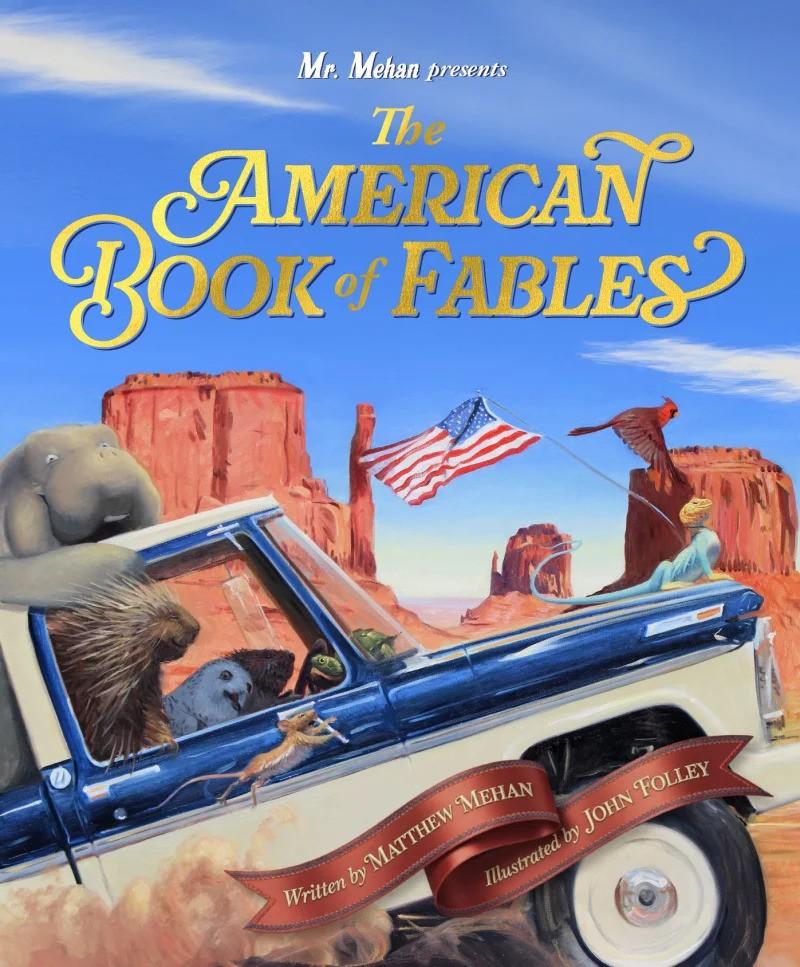
Hillsdale College professor Dr. Matthew Mehan released his latest book, “The American Book of Fables,” to commemorate the 250th anniversary of the Declaration of Independence. Beautifully illustrated by John Folley, it offers fables and wisdom that range from deceptively simple stories addressed to children to those to edify adults.
In an interview, Mehan said of his large-format book, “It invites young and old readers to rediscover the beauty of the United States of America, as well as her people, and the principles of liberty, law, and love on which it is based.” The book is part of his broader effort, he said, to revive these first principles in education and in the debates and controversies facing the nation.
Mehan is associate dean and professor at the Washington D.C. campus of Michigan-based Hillsdale College. A newspaper columnist and lecturer, he is the best-selling author of “The Handsome Little Cygnet” and “Mr. Mehan’s Mildly Amusing Mythical Mammals” for children. He also taught at Opus Dei-affiliated The Heights School for boys in Potomac, Maryland, for 20 years. He and his wife are the parents of eight children.
But his new book is not intended solely for children. It is a 395-page collection of original and adapted fables, intended as an heirloom and a supplement for parents, who, as Mehan said, are the primary educators of their children. Taking inspiration from classical tradition and the Gospels, it reimagines them in an American landscape inhabited by talking bisons, eagles, and manatees. There are sections for “Littles, Middles, and Bigs” that bear offerings for all ages. It is published by Sophia Institute Press.
Divided into 13 parts, the book ranges throughout the country, representing each region with native animals imparting wisdom, and interwoven with documents from American history and the Declaration of Independence, as well as a narrative featuring Hugh Manatee (yes, a talking manatee) on a magical pilgrimage as he teaches his critter companions about the land and people.
Mehan, a lifelong Catholic and native Missourian, sets the moral tone at the outset with the admonition from Matthew 10:16, calling on believers to be “wise as serpents and innocent as doves.” Near the end is his poem “American Morning,” which was recited publicly at the Rededicate 250 National Jubilee of Prayer and Praise in Washington D.C. in May, reminding Americans that they are the inheritors of faith and patriotism to be passed on to their descendants, Mehan said.
Mehan alluded to Genesis 3:15, where God curses the serpent that tempted Adam and Eve and put enmity between the serpent and the “seed of the woman.” This is the first glimmer of the Gospel and the Virgin Mary’s role in the incarnation of Christ, and is called the ‘protoevangelium’ and first prophecy of Christ. Mehan also refers to Christ’s Parable of the Seeds, where the sower cast seeds on both good and poor soils to represent different responses to the Gospels.
Here follows a segment of the conversation:
Q: What inspired you to write fables combining Catholic teachings, American ideals, and elements of Aesop and others?
A: In a sense, it is an unsurprisingly Catholic endeavour of ‘fides et ratio.’ I wanted to bring about something like in a church, where there is a papal flag and an American flag, with faith, morals, love of country, and love of neighbor. I’ve always thought that way. I’ve also thought a lot about a combination of those things, with beautiful images and beautiful moral sentiments, and how those come together. So when the semiquinquicentennial was coming up, I thought it would be a great gift to the country.
The phrase I use is ‘protoevangelium’ as the most important part of the book, and is the preparation of good soil for the seed of Christ, of grace, and the Gospels. That allows me to speak to all Americans because preparing the soil, in one sense, isn’t particular to Christianity, even while Christ and God’s providence are in the book. And that is something we desperately need, the parable of the seeds, where some seeds fall on poor soil, and others spring up on good soil and yield a hundredfold. That begs the question, ‘How do you get good soil?’ I think the fable tradition is the preferred method in the Western and American tradition.
Q: Which is your favorite of the fables you wrote?
A: It’s a subtle one and a central motif of what I have learned of the republican tradition from St. Thomas More, and Cicero as well, of fides et ratio. It is the image of the rose bush. It’s a fable taking place at the Grand Canyon. A man and woman build a ranch, and the man wants to plant rose bushes overlooking the canyon. But they don’t grow well. A carpenter’s son, he builds a wooden lattice and threads the roses in it, and only then does it thrive. It is then that he has a conversation with the bush, which tells him, ‘It wasn’t in our nature to grow so well on our own.’ The rancher replies, ‘Well, it is in your nature to grow with the help of a carpenter’s son.’ I take it as an image of the American republic, or any Christian republic, which is to rely on the natural carpenters, the framers of our Constitution, and our laws that prop up a free and natural people, and a society, but also of how to arrange it to thrive or fail or be better than it could otherwise.