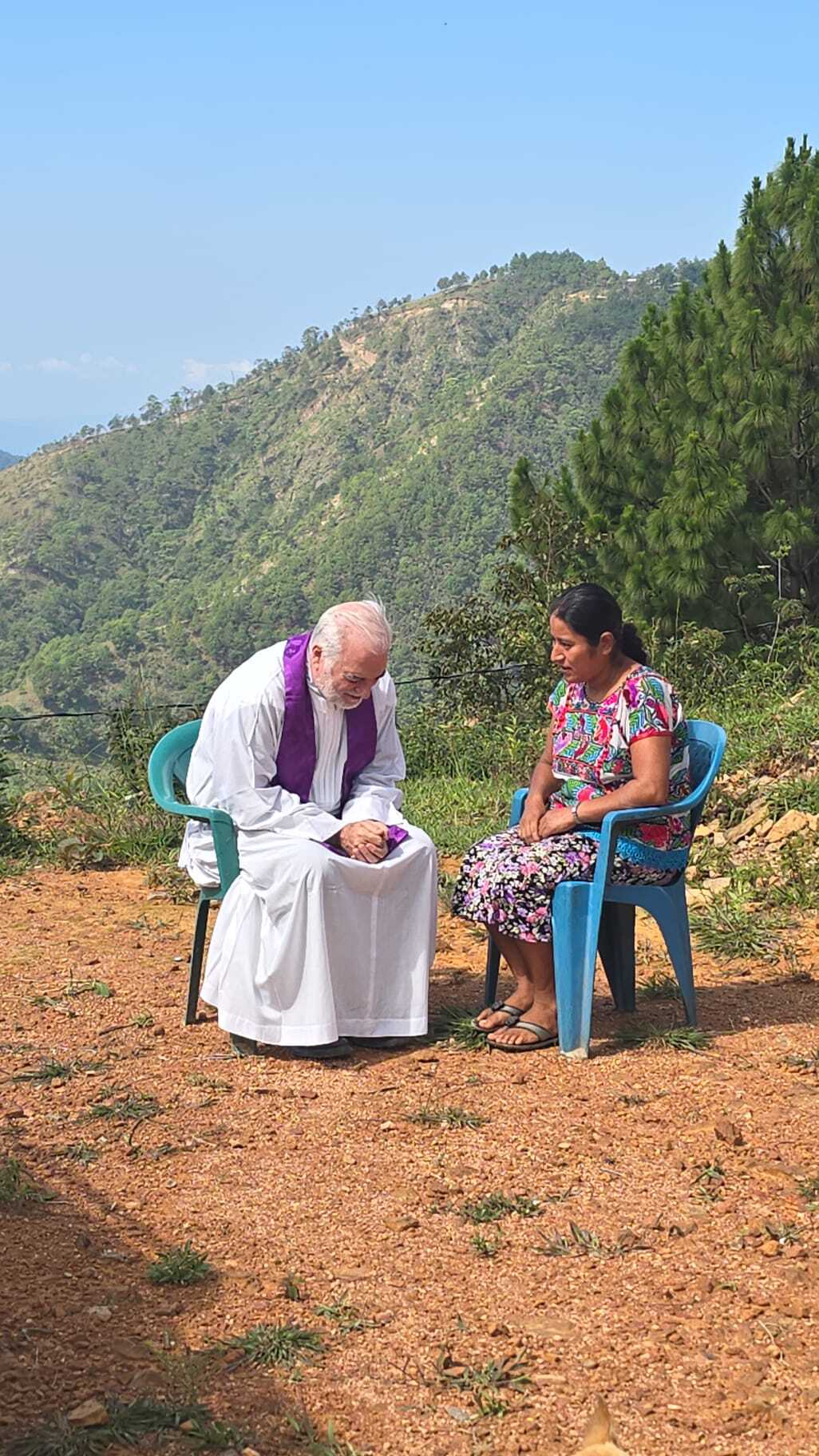
A Missionary's Appeal From The Lawless Roads Of Mexico
Lay missionaries face real risks to bring the healing words of Christ to the impoverished Mixteco people of southern Mexico, says a Letter from the Sierra Madre.
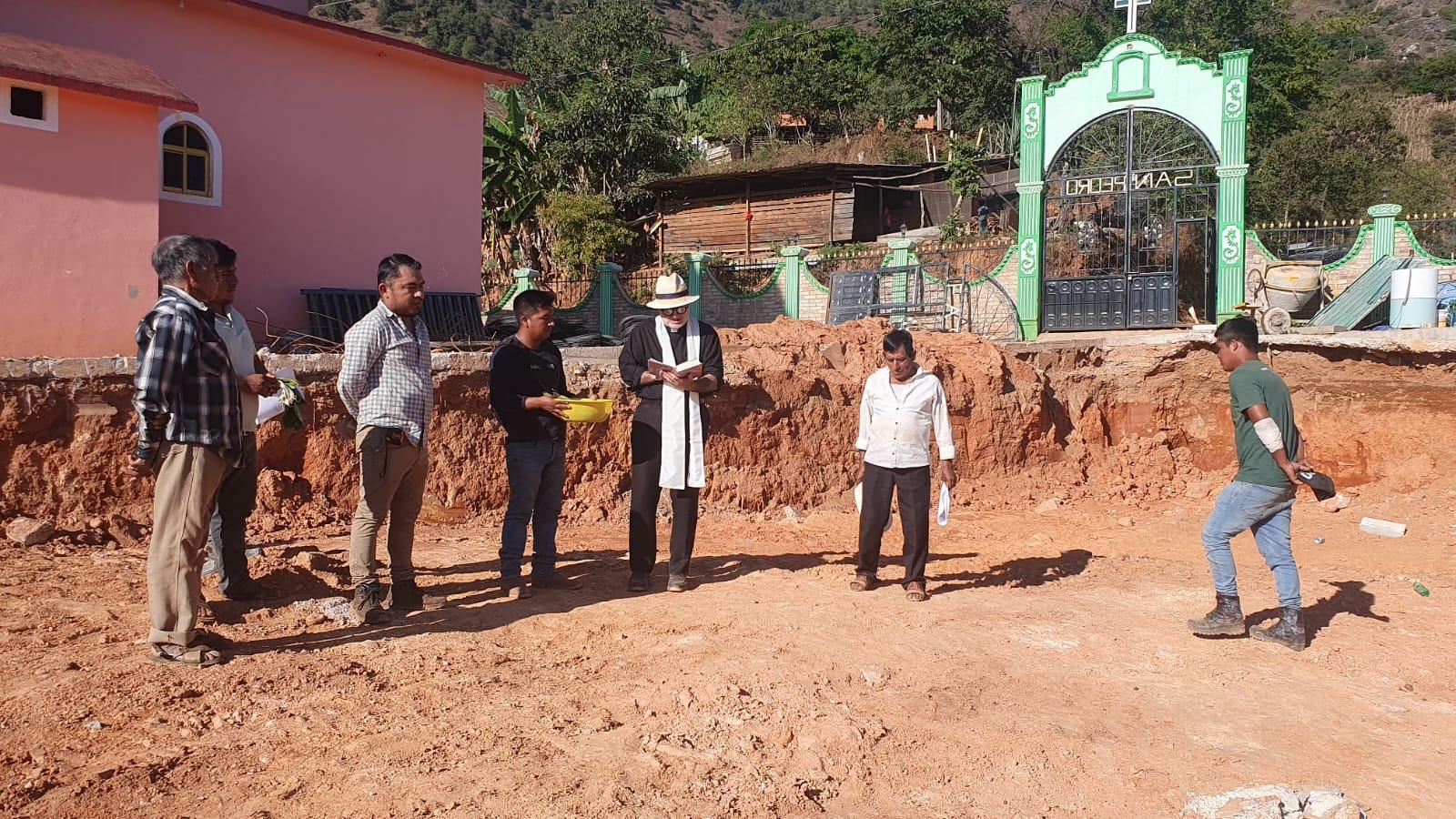
Letter from the Sierra Madre
Prostrate at your blessed feet,
Here I am, God of goodness,
Between these two solitudes—the sea
And the infinite sky. With salt on the
gunwale, the failures of its
Power are written; defeated by so much
Struggling against the sea and its waves, now
to end its journey, Xavier’s
little boat… I have confessed to You until the
very end with steadfastness and without shame. I
never, Lord, hid my light under a
bushel. Anguish and suffering
surrounded me with severity. But I
overcame my discouragements, Lord,
with determination. You gave me five
talents, and I return another five.”
(The above are the last words of St. Francis Xavier, the patron saint of missionaries, as they appear in the play El Divino Impaciente (1933) by the Spanish writer José María Pemán.}
Dear friends of the Mission of Mercy:
Almost without realizing it, another “missionary summer” is slipping away in the Sierra Madre mountain range in Southern Mexico. And this is already my fourth summer in this blessed mission! It is exciting work and requires stubborn determination to proclaim to everyone what no one had ever proclaimed before in these insurmountable, craggy mountains. The unforgettable Winston Churchill once said: “Never have so many owed so much to so few.” And that is how this year’s mission is turning out in the nearly impenetrable mountain ranges of the Western Sierra Madre in Southern Mexico. This year, hardly anyone has been willing to answer the call of Jesus Christ to serve in this mission. To each his own conscience: priests, seminarians, laypeople.
Only three magnificent women—and, to Spain’s shame, not a single Spanish woman… However, as the pastor of this mission, I can attest that the wonders these three missionaries have brought to life for the glory of God are incredible. Evangelization and catechesis camps in Rio Encajonado, El Coyul, Joya Real, Arroyo Prieto, Colonia Los Pausano, Río Negro, in Guerrero State.
There are visits every afternoon to the poorest families, to the elderly, the sick, the most marginalized and forgotten—fragments of a Christ torn to shreds, yearning for redemption and new life. Computer classes for children, youth, and the elderly; hours of catechesis; exhausting games in courtyards, alleys, and shacks. How many times we handed out rosaries and taught entire families to recite prayers their lips had never uttered before. I am not exaggerating when I say that in my nearly 44 years of missionary life, I had never evangelized among people who do not know a single word about the Catholic faith, who do not know how to pray the Our Father, the Hail Mary, or even make the sign of the cross. Nothing—they know nothing.
If this anecdote helps illustrate the point, a few days ago one of the missionaries was teaching a baptismal class to a young couple and their equally young godparents, and she asked the parents: “Why do you want to have your child baptized?” Without batting an eye, the parents and godparents replied: “Oh, well, to be godparents…” She asked, “And how many gods are there?” With a look of perplexity, the father said, looking at and counting on his fingers the statues of the saints on the side wall of the church: “Well, I’d say there are seven…” And he remained completely unfazed. That’s how things are in this mission in the heart of Mexico. “These foreign women have come only to give glory to God” (Lk 17:19 - paraphrased) That’s why I’m moved to tears when I hear them stammering their first prayers with such enthusiasm. When I arrived, I couldn’t have imagined that in a country like Mexico there were still vast regions so little and so poorly evangelized. This is first—the very first—evangelization.
That’s how these three wonderful women—from Venezuela, the Dominican Republic, and Paraguay—have thrown themselves into this summer’s adventure. While I hold the utmost respect for religious life in general, I must say that I’m growing increasingly impatient with its particularities, its quirks, its multiple demands—to go anywhere. Their stay is always subject to so many conditions, always ready to abandon the task and the mission because they and their institutions are the center of their concerns and demands, rather than the mission, the poor, and evangelization. And on top of all that, the so-called “charism.” That “whether or not it is our charism,” “it’s just that I don’t feel that this is my charism.” Charism is a precious gift that flows from the
unfathomable depths of the Heart of the Spirit. Sometimes when religious men and women say “charism,” what they really mean is whether I like it, whether I feel like it, or whether we like it as an institution. And I think to myself: What fault do the poor, poor people have in the fact that, as you say, that is not my/our “charism” (and that these are nothing but tastes, whims, and a constant flight from the cross)?
That’s what I love about laypeople. You never hear them say whether or not it’s their charism. Laypeople don’t worry about founders, constitutions, or the “spirit of the congregation”—who knows what that even is. They have Baptism, Confirmation, the liturgy, the daily Eucharist, love for Mary… all the abundant gifts offered to them by the Mother Church. When you ask a layperson for help to come on a mission, they don’t say, “Well, I don’t know if that’s my charism.” Evangelization is everyone’s charism; we are all called to evangelize and bear witness that Jesus is alive… I have seen so many religious over the years who, when the day of the Parousia comes, will still be lost in discernment and charisms… they would do better to pay attention to what the great St. Teresa of Avila wrote of Jesus in The Way of Perfection::
“The world is on fire. Men try to condemn Christ once again, as it were, for they bring a thousand false witnesses against Him. They would raze His Church to the ground—and are we to waste our time upon things which, if God were to grant them, would perhaps bring one soul less to heaven? No, my sisters, this is no time to treat with God for things of little importance.”
Blessed be the three lay missionaries, Latin Americans living in Spain, who, after a hard year of work to earn their bread by the sweat of their brow and help their families across the seas, have been the only ones this year to hear the cry of the poor, and with no other guidance than the love in their wonderful hearts, have filled these groves, hills, and thickets of the savage territories of this mission. So full of trials, hardships, and weariness—without running water, without hospitals, without electricity, with nothing more than their humble sandals and a bundle overflowing with love.
I don’t need to look very far to know what true evangelical discernment of a calling—a vocation—is, to find a true witness with his lamp lit, ready to set out at the slightest whisper of the Spirit. I have him right here in the parish in our dear Father Francisco Lunar, my friend and fellow priest, also a diocesan priest from Toledo. He had been working happily in Peru for nearly 20 years. He was a parish priest and vicar general, and one day he received a letter from our Archbishop of Toledo, Francisco Cerro Chaves, offering him the opportunity to come to Mexico to work with me when I had been completely on my own for nearly a year. The letter did not give him orders; his bishop simply presented a need and left the decision up to Fr. Luna’s judgment.
Archbishop Cerro-Chaves, our Archbishop, would have been just as happy if Fr. Luna had said yes or had preferred to stay in the Andes. But Fr. Luna didn’t hesitate; he didn’t go through any agonizing inner turmoil; he didn’t go to a monastery to do the 30-day Ignatian retreat to make his “choice of state”—none of that. He replied to his bishop almost immediately, saying that he had nothing to discern—that for him, the only discernment was his bishop’s will and a missionary need of the Church. He didn’t even ask for a trial period—a visit of a few months to discern—nothing. He burned his bridges in Peru, renounced his immigration status there, got rid of the little he had, simply said goodbye to his people, and within a few weeks was making his way down the treacherous road leading to remote Arroyo Prieto—without fanfare, red carpets, or marching bands. He remains here, worn out from “loving and serving,” as the great St. Ignatius would say, happy and content.
When I arrived in Tlapa several years ago, I told the local bishop to send me wherever he wanted. Many who have come here, to this mission, have come because they “discerned” it themselves, chose it themselves; I didn’t come—I was sent. I arrived in a little truck borrowed from the seminary’s bakery, completely lost, with the phone’s GPS useless due to a lack of signal. I was so lost that when I drove the truck into town—since I didn’t know whether I was in Arroyo Prieto or not, I saw a woman walking by, rolled down the window, and asked her, “Is this town Arroyo Prieto?” and she said, “Yes,” and that’s how I arrived at the mission, with no other discernment than being sent by a bishop who was a stranger to me. But not a stranger to Jesus Christ, who was not only the one who truly sent me, but much more—it was Christ himself who was arriving with me in that remote village.
Let’s hope that the religious and so many “discerning” bishops and priests will learn to take fewer jumps on the diving board and instead finally take the plunge.
Praying to the Lord of the Harvest
Every day we missionaries pray with all the fervor of our hearts before the humble tabernacle of the mission: “Lord, give us holy priests…” for this arduous sowing, this inhospitable mission. Men and women who feel within themselves the voice of Jesus calling them to lose their lives, to die like the grain and the cluster of grapes in the millstone and the winepress. To die for Jesus and the Kingdom every day. We do not want to deceive anyone, and when we are asked the all-too-frequent question: “And that place where you are—is it dangerous?” the answer is always the same: yes, it is dangerous, extremely dangerous, and we do not take responsibility for anyone’s life. We are companions of the Crucified One; we share the same fate as Jesus Christ on the Golgotha of every day. And since when has danger been a reason not to go to a mission field? Wouldn’t it be precisely the reason to go to a certain place? The Word of God applies perfectly to bishops, priests, and religious sisters: “For many, of whom I have often told you and now tell you even with tears, live as enemies of the cross of Christ.” (Phil 3:18). My friends, look at the list of martyrs from the past few centuries. Which vocation has given the Church the most martyrs: bishops? Priests and religious sisters from civilized countries? Laypeople living their pious lives in their wonderfully comfortable worlds? Or is it the frontline missionaries in the heat of battle? Many are confused in their “discernment” and believe that going to a foreign country and being a missionary are the same thing—but no, sir, not every priest or religious who goes abroad for a season is a missionary.
Here at the mission, we have said a novena every afternoon after Vespers and pray to the Venerable José Rivera, a diocesan priest of the Archdiocese of Toledo who is in the process of being declared a saint by Mother Church (for more information,see: https://jose-rivera.org/), asking him, with tears in our eyes, for more holy priests and religious, who will not be afraid to lose their lives for Christ. In case anyone would like to join us, here is the prayer you should recite with great faith, trust, and humility.
Evangelize until exhaustion… And with such joy in your soul!
This summer has been a time for priests, religious sisters, and lay missionaries to set out along muddy and rocky paths to proclaim the Word. Catechism at all hours, catechism in churches, catechism in homes, catechism in courtyards and pens, catechism without blackboards, projectors, or desks, on the hard ground of this extremely challenging mission. And yet, with what joy the children, young people, and adults have come to learn the unfathomable treasures of our precious Catholic faith. I will never forget when, on a recent morning, I paid a very brief visit to the community of Agua Azul. It had been a while since I’d visited them, and from a narrow alleyway, a little girl with a face covered in snot and smiles emerged and said to us, “Have you come to teach us more about Jesus?” In reality, our visit was nothing more than getting in and out of the van to briefly visit the community’s church. We still haven’t been able to return to answer that little girl’s plea, because there’s no one to offer catechesis there.
How long will the children of Agua Azul have to wait for someone to take their dirty little fingers into their evangelizing hands and teach them to make the sign of the cross? One must be very blind and very deaf to the voice of God not to recognize in the broken Christ that is that little girl the voice of Jesus crying out through her mouth… How easy it is to forget that work of mercy that says, “Teach those who do not know”!
Missionary Computer Teachers
Here, I want to extend a very special thank you to Tere, Bea, and, of course, our unparalleled Father “Fran” Luna, for the computer classes they have taught throughout the summer months. It has been moving to see the interest of so many—including our intrepid altar servers!—in learning how to use a computer. Our immense gratitude goes to Misión America: https://misionamerica.org/ for the generous support that has made our computer center possible—the only one of its kind among the Mixteco people living in the mountains—a one never knows what these boys and girls will become tomorrow, but we are determined that their lives, their minds, and their souls will not be wasted, and that when they look back, they will remember those laypeople, those wonderful nuns, those stubborn priests who never gave up and gave them their best in exchange for nothing.
When the health of our diocesan bishop fails
We had spent an entire year preparing for the day our bishop would come to confer the sacrament of Confirmation and First Communion. July 16, the anniversary of our parish’s founding. Everything was ready—an intense year of daily catechesis, the flowers, the liturgical items, the cleaning of the church—it was already late at night-- when the phone rang, and on the other end of the line was the bishop. It couldn’t possibly be good news. It wasn’t.
He was calling, with his last ounce of strength, to tell us that he was severely ill and that he couldn't make the trip the next day—a terrifying journey of more than four hours. My heart sank. Outside, I could hear the band rehearsing for the next day’s reception. In the village, the women were cooking the meat from two cows they had slaughtered to feed all those who would be visiting us from other communities. He ended by saying, “So I delegate to you, as parish priest, to preside in my name.”
Thank you from the bottom of my heart
On behalf of all of us who navigate these oceans of mud and misery every day: Father Luna, the Franciscan Sisters of Divine Providence, the Marian Missionaries, and the lay missionary sisters, thank you from the depths of my soul for all that you do to help us. Thank you to those who have given their money, prayers, sacrifices, information, words of encouragement, and support (you don’t know how much the silence of your friends hurts here on the mission). With this letter, I wish to extend very special thanks to Dr. Eva Sebastián of Spain, the sister of one of my best friends from the seminary, Father Miguel Sebastián, who, from her family and work life, is our source of comfort when we face health issues—both for the missionaries and for our people. She is the one who, along with our wonderful pharmacists in Ciudad Rodrigo, José Javier “Jota” and Mamen (and their wonderful children), helps us with our health needs. Whenever there’s a setback, she’s always on call. We send her photos of our symptoms, and she, with her clinical eye (and three Hail Marys!), diagnoses us and prescribes treatment. We send her photos of the symptoms, and she, with her clinical eye (and three Hail Marys!), diagnoses us and prescribes medication. So many people from the parish come to her with their various ailments, hoping to find relief! And we, without worrying about the time difference with Spain, make a video call so she can see the patient. She has photos of all the medicine drawers at the mission; she looks at the photo of the drawer and tells us, “In drawer number such-and-such, there’s a little green and yellow box behind a large jar…” And there’s the medicine! Thank you, all of you who, in recent days, in addition to money, have donated so many medicines, thousands of rosaries, school supplies, and so many other things.
Saint Francis Xavier, patron of missions, the ‘Divine Impatient’
I was deeply moved the first time I heard the verses I quoted at the beginning of this letter when this play was performed at the seminary in Toledo, Spain, during the feast of the Immaculate Conception. More than fifty years have passed, and I have never forgotten them, for I, too, feel that the day is drawing near when my little boat, like that of the great Xavier, will set out on its journey. I, too, hope to have confessed to Him—however poorly—until the end, with firmness and without shame… and not to have hidden the light under a bushel. And how long is the rosary of sorrows and scars from my many anxieties and no few sufferings. I ask for the grace to overcome anxieties, sufferings, disappointments, and discouragements each morning. I ask that, in the end, the handful of those five talents with which I set sail in my early priestly years may serve so that, upon reaching the final shore, I may give to Jesus another five years.
The years go by, my strength wanes, little by little the last glimmers of light fade; many of those friends from the seminary with whom I began the journey of sowing and fishing with baskets for eternal life have already died, when I dreamed of carrying lambs and wounded sheep on my shoulders, cradled in the crook of my arm. That horizon, which in those early days seemed so impossibly distant, I now see as surprisingly close… so many years of walking—not a single day have I stopped walking—because I heard your voice in the night, wounded by love for his face and his voice; and it is certainly true that, had I not heard your voice in the night, I would never have run out after Him, the Beloved. I have never seen His face, but I have never stopped hearing His voice, and at every moment I sense, in the chiaroscuro of every simple prayer, the silhouette of His presence and His song. I have never stopped seeking the One who, one day in my adolescence, sought me out and found me—and for that alone I have lived, so that everyone might know that one day I heard His call and that I love Him… more than anyone else!
We pray for everyone before the tabernacle of the mission chapel.
I bless you from the bottom of my heart in the name of the Risen Christ, missionary and Alleluia of the Father, and in the name of His Blessed Mother, the Most Holy Virgin of Guadalupe, who visited Mexico and embellished it with her beauty.
Father Christopher
Please visit our website: http://www.missionmercy.org/
For those wishing to contribute to funds for the mission, please use the bank transfer information below:
Business account for international money transfers directly to the construction contractor for our mission in Mexico, Alex Company:
NAME ON ACCOUNT: ALEXI MARTINEZ NAVA
BUSINESS ADDRESS: LUCIO CABANAS S/N COLONIA RUPERTO HERNÁNDEZ C.P.
STANDARDIZED BANK CODE (CUENTA CLABE): 0243746555111685374
ACCOUNT NUMBER: 65 51116853 7
CELL PHONE NUMBER: +52 771 365 5853
NAME OF THE BANK: SANTANDER MÉXICO
BANK ADDRESS: CUAUHTÉMOC 49, COLONIA CENTRO OMETEPEC, GUERRERO, MÉXICO C.P. 41700
SWIFT CODE: BMSXMXMMXXX
To make money transfers via Bizum, Paypal, and banks, please refer to the donation page at the MissionMercy.org website here: https://missionmercy.org/dona/
To donate from the United States via Bank of America, use the following:
Name on the account: Christopher Hartley
Account number: 483097440575
Routing number: Paper: 021000322 & Electronic Wires: 026009593
For Zelle transfers, use the email address: hartley.christopher@gmail.com
See earlier coverage of Father Christopher here:
https://shakenterra.com/heroic-priest-evangelizes-among-isolated-poor-mexico