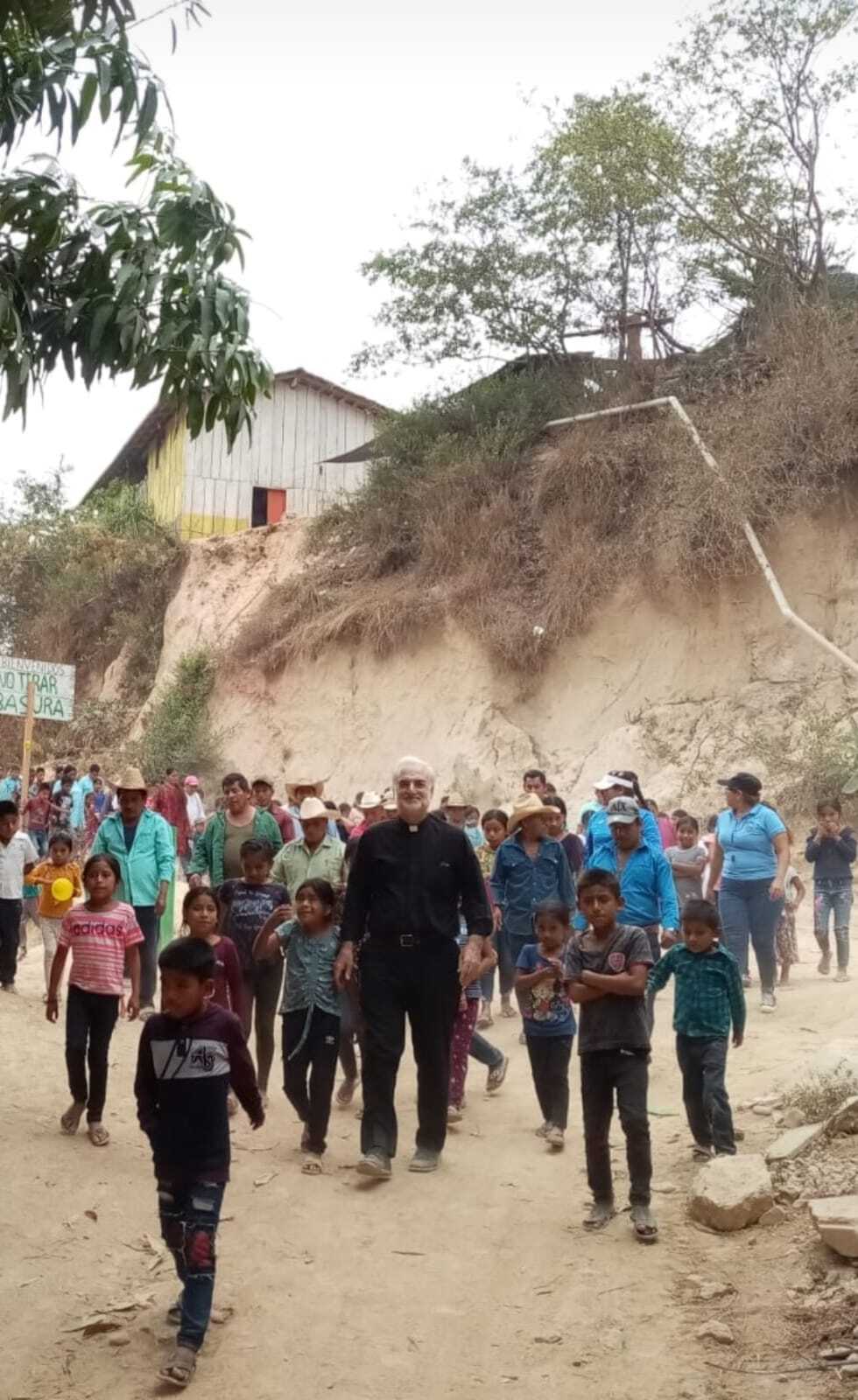
Priest Risks His Life to Bring the Gospel to Mexico’s Remote Mountains
For more than three years, Fr. Christopher Hartley has traveled dangerous mountain roads to evangelize Mixteco communities where the Church has long been largely absent.
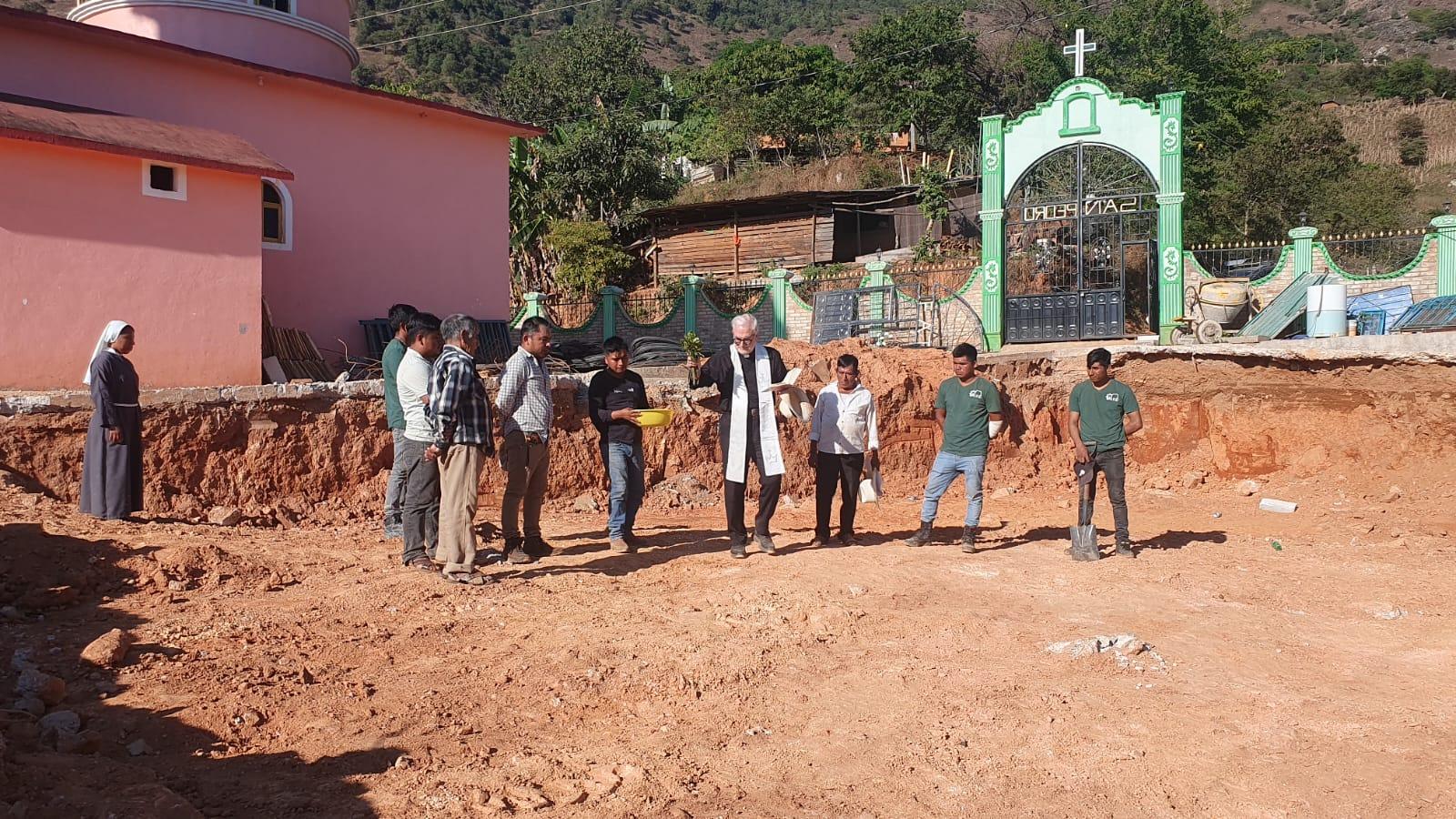
Fr. Christopher Hartley is neither complacent nor conformist, but remains valiant and active as a missionary priest, 43 years since his ordination at the hands of St. John Paul II.
In his latest letter to his supporters, he reflected on the joys and challenges of serving the Mixteco people, who live in a mountainous and remote region in Guerrero state in southern Mexico. During more than four decades of priestly service, Fr. Hartley (67) has spent only 22 months in his native Spain, having left behind a wealthy and prominent Anglo-Spanish family. From his youth, he was drawn to the missions and has gone where others did not dare to go. In an interview, he emphasized that being a missionary is “the only thing I’ve ever wanted to be in this life.”
After serving a Hispanic parish in New York City under Cardinal John O’Connor, he asked for and received a mission to impoverished Haitian cane workers living in the Dominican Republic. Having vowed even to give his life to relieve the Haitians’ onerous poverty and oppression as they worked on the sugar plantation of a powerful family, he eventually ran afoul of his bishop and the country’s government. His work in the Dominican Republic is recounted in the documentary film The Price of Sugar, narrated by the famed actor Paul Newman.
After Fr. Hartley managed to see some relief for the Haitian plantation workers, and undaunted even by having a gun put to his head by a plantation enforcer, he was nonetheless expelled by the government of the Dominican Republic. Leaving the Caribbean, he was then called to Ethiopia, where he celebrated the first Mass in Gode: an entirely Muslim area. Under constant surveillance by Muslims, he celebrated the Eucharist secretly and in solitude, working quietly to announce the Good News. It was in Ethiopia that he suffered severe injuries in a road accident and was hospitalized for several months in Spain. But he sought yet another challenge in the missions as an envoy from his Spanish diocese.
Since 2023, he has served in Guerrero, a state in southern Mexico, which is best known for its resort city, Acapulco, but also for its violent narco-terrorist cartels. Missionary religious and diocesan priests have long been loath to go up into Guerrero’s Sierra Madre mountains. “Being sent into the interior was considered a punishment,” Fr. Hartley said. He tells anyone who asks that going into the mountains presents a serious risk of death at the hands of the cartels, or because of the dire physical conditions. Any missionary priest, religious, or layperson wishing to go on the mission must be personally interviewed by him.
Even while the Church has been present in Mexico for centuries, a great number of people in the remote interior remain uncatechized, clinging to a mishmash of Catholic and native beliefs and practices. Fr. Hartley drives a 4X4 along rough roads and trails in Guerrero to preach the Gospel where the Church, in many cases, is merely a memory. Far from resting on the fruits of his labor or settling for statistics, he laments that, in many places, the Church either does not reach people or is being replaced by evangelical Protestants.
Fr. Hartley has just published the ninth of his Letters from the Sierra Madre, found here and on the website of Mission of Mercy Foundation. With a poetical bent and prophetic witness, he reveals to the world the progress made in evangelizing the poor Mixteco people of Guerrero.
Fr. Hartley writes that in the third year of his missionary apostolate, only four people joined him in his efforts this summer. He goes to far-flung hamlets and villages where priests, if they ever visited, might have been seen only once a year. Under the authority of the bishop of the Diocese of Tlapa Guerrero), Fr. Hartley has served more than 160 villages and hamlets where he was alone from his arrival in 2023 until his friend, Spanish Archbishop Jesús Sanz-Montes came for a visit in 2025. There is no other presence of the institutional Church there without the mission parish located in the village of Arroyo Prieto.
“It’s a terribly dangerous area. Kidnappings, robberies, and murders are frequent. It’s no secret to anyone—that’s how it is throughout Mexico. There are no police or law enforcement, and there is no law other than that of the strongest or the most violent. It’s very dangerous,” notes Fr. Hartley in an interview, adding that he would never have gone there if he weren’t a priest.
“It’s not a place I’d recommend to anyone with a family—not even to help out—unless they’re aware of the risk of death,” he said.
There is little government in the mountains, no electricity, no hospitals or clinics, and no schools. The people there once produced marijuana, often under duress, for export by violent narco-terrorists. However, the drug cartels have moved on to more profitable methamphetamine and thus left the locals with few profitable sources of income. This has meant outmigration of many young adults who go to the United States seeking work, and the abandonment of children who live in squalor with the elderly.
Fr. Hartley seeks to relieve the material poverty of the Mixteco people, but also evangelize and teach the Faith. In his letter, he writes: “There are visits every afternoon to the poorest families, to the elderly, the sick, the most marginalized and forgotten–fragments of a Christ torn to shreds, yearning for redemption and new life. Computer classes for children, youth, and the elderly; hours of catechesis, exhausting games in courtyards, alleys, and shacks. How many times we handed out rosaries and taught entire families to recite prayers their lips had never uttered before.”
He is impressed by the generosity of Mixteco communities the mission is evangelizing. “They even give what they don’t have. It’s very touching that, when [volunteers] go out in pairs, it’s the people themselves who feed them—they share their food, their tortillas, their beans, and their corn. It’s the poor who give,” he said. Fr. Hartley explained that many of the Mixtecos “don’t even know what it means to have….Some say to me, ‘Father, give me something.’ When I ask them what they want, they reply, ‘Whatever you want. I have nothing.’”
For Fr. Hartley, the most pressing urgency and solemn challenge is that for the Mixteco people, the word “love” is not associated with faith or religion. “God is not love. It’s not that they deny it; it’s that they don’t know it. That’s why they offer sacrifices to their god. They have to appease him, fear him, and ask him for things. They even use God by asking him to inflict harm. It’s not uncommon for someone to come and request a Mass so that God will give their enemies ‘what they deserve.’”
Fr. Hartley praised three lay women from the Dominican Republic, Paraguay, and Venezuela, who came this year to aid the mission, as well as a fellow priest from Spain, Fr. Francisco Luna. In his latest letter, the priest was critical of the response of religious congregations to the missions: “While I hold the utmost respect for religious life in general, I must say that I’m growing increasingly impatient with its particularities, its quirks, its multiple demands—to go anywhere.” Staying at the mission, he wrote, “is always subject to so many conditions, always ready to abandon the task and the mission because they and their institutions are at the center of their concerns and demands, rather than the mission, the poor, and evangelization.”
While admitting that “charism” is a precious gift from the Holy Spirit, Fr. Hartley said that when some religious cite their “charism, what they really mean is that they do not choose the perilous work of the mission and deny the call to evangelization. He reflected: “What fault do the poor, poor people have in the fact that, as you say, that is not my/our ‘charism’ (and that these are nothing but tastes, whims, and a constant flight from the Cross)?”
He praised Fr. Luna, who was called from his parish of 20 years in Peru and now works in the Mexican mission. When Fr. Luna was asked if he wanted to go to Mexico, Harley wrote that his fellow Spaniard “didn’t hesitate; he didn’t go through any agonizing inner turmoil; he didn’t go to a monastery;” he instead came to treacherous Guerrero “without fanfare, red carpets, or marching bands.” He joined Fr. Hartley, who had worked nearly for a year, and remains at the mission “worn out from ‘loving and serving,’ as the great Saint Ignatius would say, happy and content.”
“That’s what I love about laypeople. You never hear them say whether or not it’s their charism,” Fr. Hartley wrote. “Laypeople don’t worry about founders, constitutions, or the “spirit of the congregation”—who knows what that even is. They have Baptism, Confirmation, the liturgy, the daily Eucharist, love for Mary… all the abundant gifts offered to them by the Mother Church. When you ask a layperson for help to come on a mission, they don’t say, ‘Well, I don’t know if that’s my charism.’ Evangelization is everyone’s charism; we are all called to evangelize and bear witness that Jesus is alive… I have seen so many religious over the years who, when the day of the Parousia comes, will still be lost in discernment and charisms.”
Fr. Hartley and fellow missionaries are faced with the endemic syncretism of the Mixteco people, who combine pagan beliefs with Catholic teachings and imagery. He described that for the Mixtecos, “The god of rain is the same as the Heart of Jesus,” and “Jesus Christ is not the King of Kings, but just another saint to whom people pray.” Another challenge is the language barrier, since the majority of the Mixteco population do not speak Spanish. According to Mexico’s National Institute of Indigenous Languages, there are approximately 500,000 Mixteco speakers, located in 23 municipalities in Guerrero.
According to the priest, the missionaries make themselves understood through interpreters during visits and Sunday homilies. Fr. Hartley said he loves the Mixteco people and is moved by their poverty and simplicity. He continues to ask for donations of funds for his work, in addition to school supplies, medicines, and rosaries. The spiritual challenges are steep among the Mixtecos, who, while they don’t know that God is Love, this is not due to wickedness. It is because they have never been effectively evangelized. He said in the interview, “The question is not why they are this way, but where the Church was while these people became this way—why the Gospel has not been proclaimed to them. They themselves tell me: ‘If all this is true, why has the Church taken so long to come and tell us?’ The finger points back at us. Of course, the structures of the state are not present, but neither are those of the Church.”
Fr. Hartley said that in contrast to what he sees in mission lands, “I don’t know of a parish of wealthy people that doesn’t have a priest, but here, millions of people are waiting for someone to come.” To address challenges to evangelization, he envisions having small teams of missionaries living very simply in the villages where the Mixteco people are. “This is about living more ‘spartanly’—finding a room, flashlights, canned food, a plate, and little else. By living with them, you get to know them better and don’t waste a minute traveling back and forth. This yields greater evangelistic fruit and lower costs,” he said.
The lack of catechesis is striking among the poor Mixteco people. In an interview, Fr. Hartley said, “There is an enormous amount of work to be done with the children and youth. People who are lost, disoriented, who do not know Jesus Christ, and terribly addicted to alcohol—most have not received the sacraments.”
Fr. Hartley said, finally: “We urgently need more evangelizers—priests, religious sisters, and lay missionaries—who are willing to come and lay down their lives for the Kingdom, out of love for these people who do not know that they are loved to the point of madness.”
“There is an enormous amount of work to be done with the children and youth,” he says, “people who are lost, disoriented, who do not know Jesus Christ, terribly addicted to alcohol—most have not received the sacraments… We urgently need more evangelizers—priests, religious sisters, and lay missionaries—who are willing to come and lay down their lives for the Kingdom, out of love for these people who do not know that they are loved to the point of madness,” Fr. Hartley said finally.
To contribute to Fr. Hartley’s mission, click here and the Mission of Mercy website here.