Muslim Candidate For US Senate Continues To Compare Sharia To Catholic Canon Law
A darling of progressive Democrats, Abdul el-Sayed opposes US military aid to Israel and is running for the US Senate in Michigan
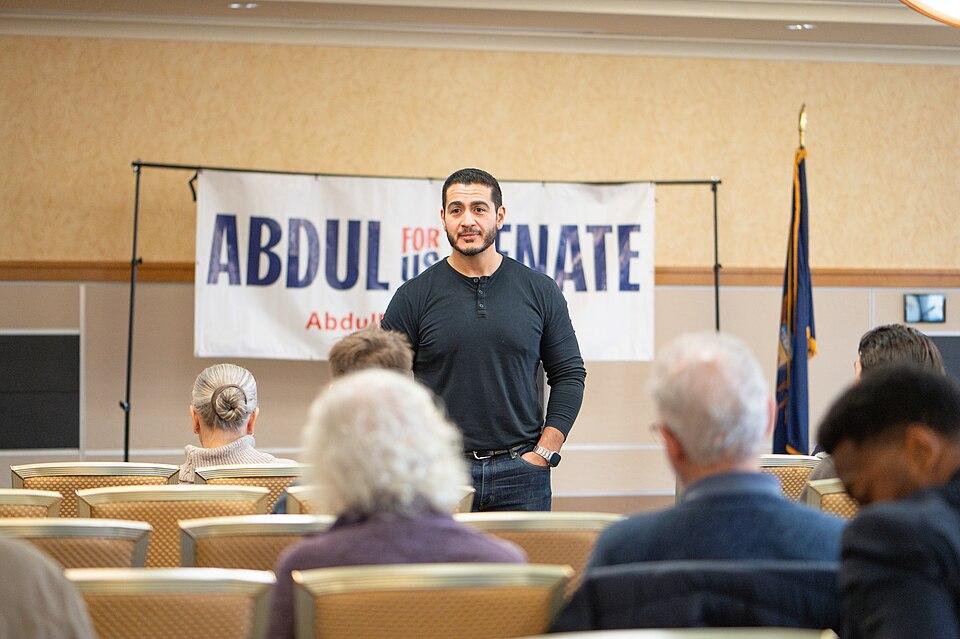
U.S. Senate candidate Abdul El-Sayed invoked Catholic canon law during a campaign appearance in Michigan, when an audience member sought clarification about the Muslim Democrat’s adherence to Shariah law: the comprehensive civil and religious rules used in Muslim-majority countries.
The undated video on social media was shared on October 12 by noted Danny Burmawi, a Christian convert from Islam and founder of the Ideological Defense Institute. He is an outspoken critic of Islam and author of Islam, Israel and the West.
As El-Sayed addressed a theater crowd, a large middle-aged white man stood up and told the audience: “I voted for Biden...I love all of you. This guy seems great. He really does. I like this guy. The problem is his book says something different than my book.” He was greeted by shouts and jeers.
El-Sayed responded, "He said he likes Democrats. He voted for Joe Biden, but his problem is that his book says something different than my book. I'm grateful that you're here….But I'm going to tell you this: the book that matters to all of us is the U.S. Constitution.” The audience cheered approval, while the man gave a thumbs up.
“When it comes right down to it, at the end of the day, I'm going to swear an oath to the U.S. Constitution. You're Christian. Do you follow canon law?" El-Sayed said. When the man responded, “I’m vaguely aware of canon law,” El-Sayed said, “I would recommend, as a Christian, that you go read canon law, because it is supposed to pattern your life’s choices as a Christian. Because of the U.S. Constitution, you have the right to live according to canon law, and also because of the U.S. Constitution, you don't get to enforce canon law on anyone else. All we're asking is that in the U.S., you pray as you choose. I pray as I choose to pray…But to make the argument that America is not big enough for all of us to pray as we choose to pray or not pray at all seems to be a disrespect to the Constitution.”
Wearing a white T-shirt emblazoned with a crusader red cross, the man was escorted from the theatre by a uniformed officer. As El-Sayed led a chant of “USA! USA! USA!” the crowd responded likewise, as did the man being ushered out of the venue. EWTN News sent a request to the El-Sayed campaign requesting clarification. No answer was received at close of business October 15.
This is at least the second time El-Sayed, who has Egyptian and US citizenship, has referred to canon law, which is common to both the Catholic and Orthodox Churches, but rarely cited by Christian sects. Burmawi commented on X: “Abdul can swear whatever oath he wants. When it comes to serving Islam, everything is justified.”
On August 25, Fox News host Jesse Watters brought up El-Sayed’s opposition to a ban on Sharia law, in which the latter compared it to White supremacy. El-Sayed responded, “Do you know what canon law is, Jesse? …canon law is the name for Christian law…Nobody is trying to push Sharia law on anyone else. Just like I hope nobody is trying to push canon law on anybody else, because we live in an America where you should have the freedom of your religion.”
Commentary on social media highlighted the differences between the Christian and Muslim traditions. For example, activist Pamela Geller noted on X, "Canon law applies to Catholics. There is no compulsion in Canon law. Jewish law applies only to Jews. There is no compulsion in Jewish law. It is voluntary. The sharia is a comprehensive legal system governing every aspect of human life, and asserts authority over non-Muslims." "Sharia law is incompatible with Western Civilization," Carl Jackson posted on X. The political pundit wrote, "I’m tired of El-Sayed playing the victim card in an attempt to avoid legitimate scrutiny of Islam."
Unlike Sharia, which can regulate broad areas of personal and social life for anyone living in a Muslim country, Catholic canon law only governs the Church’s internal affairs, including the organization of dioceses and parishes, the rights and obligations of the faithful, religious education, sacramental practices, marriage tribunals, and ecclesiastical procedures.
In Muslim countries, Shariah law calls for severe restrictions and penalties. For example, in Sudan, Muslim women are prohibited from marrying Christian men, according to the U.S. Commission on International Religious Freedom. In Nigeria and Pakistan, Christians and Muslims have been condemned to death on charges of blasphemy or disrespect to Muhammed, the founder of Islam. Adherence to Shariah law has often been cited by Muslim terrorists for the murder and rapine of Christians and their property.
In contrast, Catholic canon law is limited in scope and does not serve as a substitute for a country’s civil or criminal law. Even in predominantly Catholic countries, canon law does not automatically become the law of the land.
El-Sayed has been outspoken in his denunciations of his Republican opponent, Mike Rogers, and is also outspoken about his religious faith and cultural heritage. In an interview with Simran Jeet Singh, El-Sayed said, “I got to learn about Prophet Muhammad, peace be upon him, and found this man who just had this impeccable character, the kind of character that I admired so much in my grandmother — the kind of temperament that always sought to be kind, to be compassionate, to be softhearted with those who are oppressed, and to be courageous. That’s when I found my faith again. That’s when I started to really practice my faith again on my own terms, and that’s how I try to live my faith today. I think I fail more often than I succeed, but it’s the aspiration I have.”
Former President Barack Obama and former Vice President Kamala Harris have endorsed El-Sayed, as have other prominent Democrats. El-Sayed has been identified as a progressive who supports socialized medical insurance, abolishing Immigration and Customs Enforcement (ICE), and ending US military funding to Israel. He would be the first Muslim and Egyptian-American member of the US Senate. He has been identified by the New York Times as a “fierce critic” of Israel.