Muslim US Senate Candidate Raises False Equivalence Of Canon Law And Sharia
Experts on canon law and Catholic-Muslim relations disagree with Democrat El-Sayed's comparison of 'Christian law' and sharia.
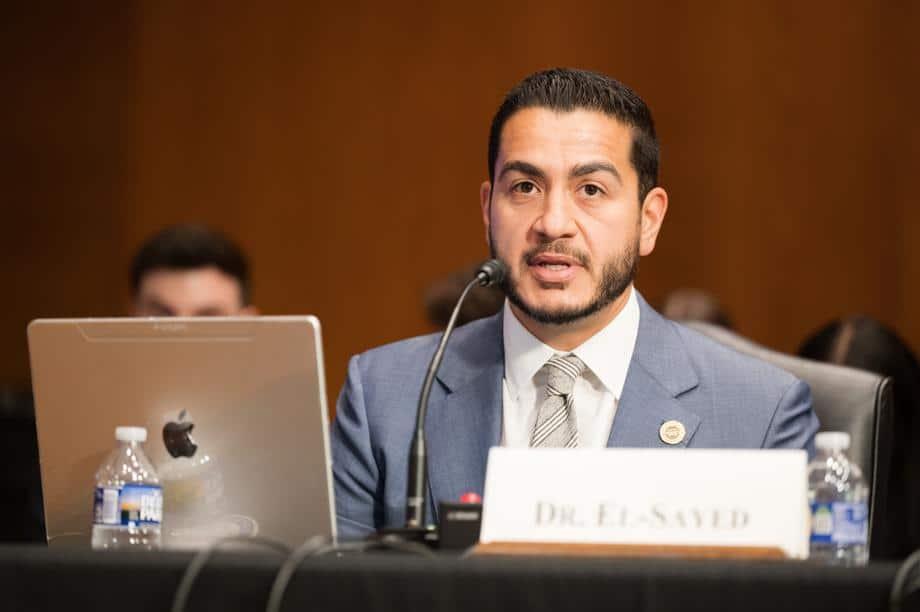
Mohammed Abdulrahman El-Sayed wikimedia.
In the closing days of a hotly contested U.S. Senate race, Michigan Democratic candidate Abdulrahman Mohamed El-Sayed released an ad on “Prayer”, in which he says that as a Muslim he prays every day.
Commenting on the ad, Kelsey Reinhardt, president and CEO of the advocacy organization CatholicVote, said: “I take him at his word that he is a man of prayer and he, as an American Muslim, deserves the same religious liberty we Catholics have fought to protect for two centuries.”
“What I question is something else,” Reinhardt continued. “El-Sayed has repeatedly answered fair questions with false equivalences, and he has put Catholics and our Church at the center of them.”
Reinhardt was referring to El-Sayed’s repeated equation of Catholic canon law with sharia. Addressing concerns about his Islamic faith and fears over the imposition of sharia, in a video shared on social media, El-Sayed emphasized that if elected to the Senate, “I’m going to swear an oath to that U.S. Constitution.”
Earlier in October, El-Sayed told a town hall questioner in Michigan, who identified himself as a Christian, that “because of the U.S. Constitution you have the right to live according to canon law and also because of the U.S. Constitution you don’t get to enforce canon law on anyone else.”
The issue first came to the forefront during an Aug. 24 interview with Fox News host Jesse Watters, when El-Sayed asked, “Do you know what canon law is, Jesse?...canon law is the name for Christian law…Nobody is trying to push sharia law on anyone else. Just like I hope nobody is trying to push canon law on anybody else, because we live in an America where you should have the freedom of your religion.”
El-Sayed’s campaign staff did not respond to a request for clarification.
Gabriel Said Reynolds, who serves on the Vatican Dicastery for Interreligious Dialogue with Muslims and is a professor of Islamic Studies and Theology at the University of Notre Dame, said that sharia, translated as “path,” encompasses theological and practical dimensions of Islam. Reynolds said that for Muslims, “God’s will for humanity is sharia.”
Sharia also has implications for non-Muslims. For example, Islamic law allows for a head tax known as jizya on Jews and Christians. At different times Christians in the Islamic world have suffered from abduction, enslavement, subjugation, and forced conversion.
Dr. David P. Long, who teaches canon law at the Catholic University of America, said that comparing canon law and sharia may help illustrate believers’ “freedom to observe religious obligations,” but “does not establish that canon law and sharia share the same sources of authority or jurisdiction.”
The Code of Canon Law is not a civil code for non-Catholics, but orders the life of the Church. Eastern Orthodox and Oriental Orthodox churches, as well as national churches of the Anglican Communion, also have their own canon laws.
Long said of El-Sayed’s comparison: “As an appeal to the religious freedom protected by the Constitution, the analogy makes a useful point: Catholics and Muslims alike may seek freedom to observe their religious obligations without thereby claiming authority to impose those obligations on their fellow citizens. That constitutional argument does not depend on the two legal traditions being equivalent.”
“Sharia concerns the ordering of life according to God’s will, including worship and personal conduct. The Islamic legal tradition also addresses matters that modern states regulate through civil and criminal law,” Long said.
Islamic schools of thought differ, and Muslim countries interpret Islamic law in varying forms. “Islamic jurisprudence also provides rules for civil government, including those affecting non-Muslims. The distinction is substantial, but it must be stated without reducing canon law to administrative rules or treating every Muslim’s religious observance as a proposal for state enforcement,” he added.
Islamic jurisprudence has an extensive relationship with government, Long noted, who said that “Classical Islamic law also regulated the status of non-Muslims under Muslim rule.”
For Christians, Long contends, the central issue concerning sharia is the distinction between religious freedom and coercive state authority. The Second Vatican Council affirmed religious freedom and the proper autonomy of the Church and political community. “Canon 748 §2 prohibits compelling anyone to embrace the Catholic faith against conscience, while canon 747 §2 recognizes the Church’s responsibility to teach moral principles concerning the social order,” he said.
Canon law and sharia are not equivalent, nor do they establish a candidate’s policies. Long concluded: “These distinctions matter for believers and nonbelievers alike. Respect for religious freedom does not require agreement with every religious teaching. It does require distinguishing the freedom to practice a faith from a claim to exercise coercive civil authority over others.”
Reinhardt, meanwhile, squarely accused El-Sayed of drawing a “false equivalence” between the two systems.
“The Code of Canon Law is the internal legal order of the Catholic Church. It governs how the Church administers sacraments, organizes dioceses, and disciplines its own clergy. It makes no claim over the criminal code of any nation,” she explained.
”Classical sharia is a different kind of thing. Many American Muslims understand it as a matter of personal devotion, and that is their right,” she continued. “In its historic jurisprudence, though, sharia is a comprehensive legal order. It reaches into family law, criminal punishment, and the governance of the state. That is why it is written into the constitutions of several nations, and canon law is written into none,” Reinhardt pointed out.
“One can respect both traditions and still see that they are not the same. A Senate candidate should know the difference,” she said.