A 'Paradigm Shift' In Catholic Workplace Wellness
Christ Medicus' HOPE program addresses a culture opposed to a Christian anthropology and understanding of human nature.
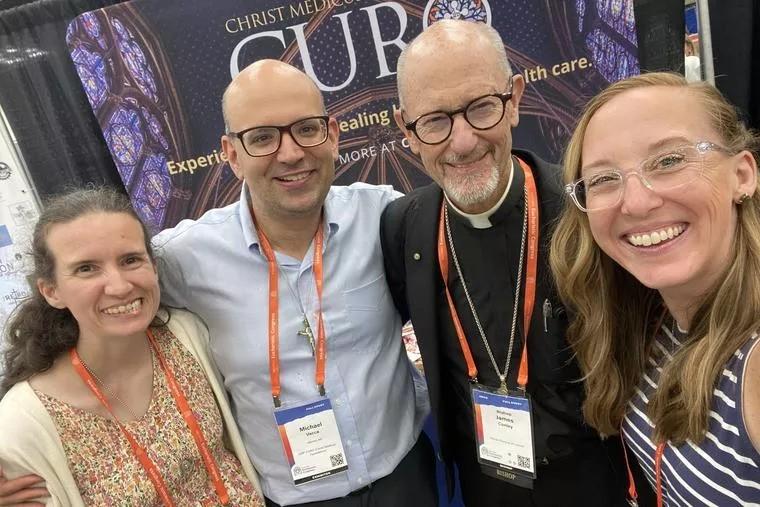
L to R: Sarah Vacca, Michael Vacca, Bp James Conley, Jen Cox of Christ Medicus.
Employees of Michigan dioceses are praising the HOPE wellness program, saying it has helped them meet personal and spiritual goals.
Michigan Catholic Conference (MCC) executive David Maluchnik said Michigan’s bishops sought a “mission-aligned partner” offering an employee assistance program that is “in accord with the teachings of the Catholic Church.” On behalf of the state’s seven Latin-rite dioceses, MCC negotiated with Christ-centered, prolife Christ Medicus Foundation (CMF) to provide HOPE to approximately 8,000 clergy and lay employees.
HOPE offers whole-person health and wellness support, including spiritual direction, personalized wellness coaching, bioethical guidance, and mental health counseling. CMF describes HOPE as a “paradigm shift” in Catholic workplace wellness that may spread nationwide. The seven Latin-rite Michigan dioceses are the first in the country to offer HOPE to their clergy and lay employees.
Maluchnik added, “HOPE’s focus on the whole person - spirit, mind, and body, grounded in the truths of the faith – resonated with our needs.” Open enrollment began in October 2025 and is ongoing. MCC executive Michelle Dolis-Brady related in an email, “HOPE offers a wide array of resources that are easily accessible, confidential, and meet people wherever they may be in their spiritual life with the assistance of trained and knowledgeable Catholic professionals."
Tracy Gabrielson, a self-described “lunch lady” at St. John Catholic School in Fenton, north of Detroit, said the HOPE life coaching services have helped her stay focused on personal growth. “It’s nice to talk to someone and touch base about personal goals because we all have struggles,” she said, adding that counselors “help you become a better you.” As a result, Gabrielson said she is now reading the Bible and praying more frequently.
CMF Catholic Wellness Director Rebecca Wilson said HOPE integrates science with Catholic theology. “We want to combine the best of what science offers, with the Church’s theology and the writings of the Church Fathers, and accompany people in the fullness of who they were created to be to help them flourish in lives of virtue,” she said.
Darren Hogan, a fundraiser for Catholic Charities of West Michigan, is using HOPE’s spiritual, psychological, and medical wellness offerings. “I've always wanted to know the truth about myself and the world around me. I believe Jesus founded the Catholic Church, so that's my first stop when I have questions,” he said. HOPE, Hogan added, helps him “flourish as a whole person: spirit, mind, and body.” He has also taken several of HOPE’s online courses.
Hogan noted that while priests provide the sacraments, they may lack the time or training for long-term spiritual direction. “HOPE offers superior spiritual direction from lay people,” he said, pointing to formation programs at Franciscan University of Steubenville, Avila Institute in partnership with Heart of Christ, the Lanteri Center for Ignatian Spirituality, and the Diocese of Joliet, Illinois.
Recalling St. John Paul II’s theology of the body, Hogan called HOPE is the late pontiff’s “dream come true.” Hogan said HOPE is transformative. “For me, HOPE has been life-changing, and I’m only four months in.” He described it as part of a broader Catholic wellness movement that includes: CatholicSpiritualDirectors.com, Catholic PsychInstitute, and CatholicTherapists.com.
Bishop James Conley of Lincoln, Nebraska, a CMF board member, said in an exclusive interview that HOPE reflects the Church’s holistic understanding of the human person. “The unique beauty of Christ Medicus and the HOPE program is that they take the whole person into consideration, body, mind, and soul. It is rooted in a truly Christian anthropology,” he said, noting that discussions are underway to bring HOPE to his diocese.
CMF Executive Director Louis Brown said HOPE responds to deficiencies in the U.S. healthcare system. “The reason for Christ Medicus is to fulfill the Church’s mission and, in particular, St. John Paul II’s vision for the culture of life in healthcare,” he said, adding that “Burnout, disconnection, and mental health struggles are real issues in today’s workplaces, especially in ministry-oriented roles.”
HOPE operates alongside traditional insurance plans and remains consistent with Church teaching, said Michael Vacca, who oversees CMF’s team of eighteen spiritual directors. “HOPE offers to direct people to the heart of Christ,” Vacca said, emphasizing the shortage of trained spiritual directors. “This is about helping people to discover, ‘What is the Lord saying to me? How can I cooperate with him? How can I grow into the person that he is calling me to be?’”
Catholic clergy and laity may also access HOPE independently if it is not available through an employer.
Reflecting on his own health challenges, Bishop Conley concluded, “Inside each of us is the truth of our identity, that we were created by God, who is Love, and are made to love and be loved. Tragically, in our current culture, the life, dignity, health, and identity of so many have been compromised, particularly in health care.”