Saint John Vianney Set The Standard For Holy Priests
'You lead me to the town of Ars, and I will show you the path to heaven!'
"Let him be a priest, but don't put him in charge of confessions, because he doesn't have the knowledge for that job," they said when they ordained him.
Well, that became his life's work, and he did it exceptionally well. This is the Curé of Ars.
Saint John Vianney was born in 1786, three years before the bloody French Revolution began, which took more than 200,000 lives and many thousands of martyrs who figure into the Roman Martyrology.
After spending his life as a peasant and deserting from Napoleon's army, Saint John Vianney was ordained a priest at the age of 29, which was late for the era. His difficulties with learning Latin and his other studies (although his sermons did reveal his learning, caused a delay in his graduation.
His childhood had not been easy: from a humble family but with a strong Catholic tradition, he had received his first communion from the hands of a so-called "refractory" priest, that is, one of those who had sworn fealty to the revolutionary government's Civil Constitution of the Clergy decreed by the Republic.
They hesitated about ordaining him. But due to the shortage of priests following the large number of them murdered during the French Revolution. But, after seeing his piety, he was ordained in 1815 and assigned to an insignificant little town, Ars, about 30 miles from Lyon, where there were barely 300 people.
Vianney walked to his assigned parish, but did not quite know which route he should take. On his way there, he met Antoine Givre, a peasant boy, and asked him for directions. Antoine told him the route to take, and the priest replied: “You have shown me the way to Ars, I will show you the way to heaven.”
There is now a monument outside Ars that marks the exact spot of the meeting between the Curé of Ars and Antoine Givre.
It is said that when the priest arrived at the rectory, it was in ruins and the parish had been without a priest for some time. Only one person regularly attended Mass. But when the Curé of Ars died, only one person did not attend the Mass, which shows what he accomplished with God's help.
He began his priesthood doing the most important thing a priest can do: preach the truth and administer the sacraments. For this, he was given the threefold "munus" or "burden": to govern the flock, to teach, and to sanctify. He spent hours in the tiny parish church, which could barely hold 50 people, keeping it permanently open so that people could become accustomed to visiting the Blessed Sacrament. Everyone was struck by the dedication of this gaunt, thin, penitent priest, who always answered with a smile.
Little by little, with his patience and humility, although also with his iron character, he began to win souls, from the pulpit and from the confessional. He spoke hard truths and did not water down the doctrine of the Church, but at the same time, he was merciful to the repentant sinner, with whom it was enough to spend a few minutes in the confessional to change his life.
It was in that parish that admirable and memorable things happened. For example, he converted the Lehman brothers, two Jewish rabbis who would later found a religious congregation to preach to the People of Israel. It was there that the demon stalked him almost every night, preventing him from sleeping. And it was there that he gave one of those beautiful teachings about what prayer is:
He often saw a peasant in his church who would bring his tools and enter the parish, sitting in one of the back pews. He used neither prayer books nor a rosary; he was content simply to gaze at the tabernacle. Curious, one day the Curé of Ars could no longer stand it and asked him:
– “My dear friend, tell me, what prayer do you say when you are in church?”
– “Oh, Father!” replied the peasant, “there are many times when I cannot pray. Then, I simply look at Jesus. I look at Him and He looks at me.”
Thus the holy priest understood how even the simplest people can achieve a prayer of simplicity higher than even a Carmelite.
He ate little, slept even less. He used to boil potatoes in a bag and leave them hanging in the kitchen so that at midday he could eat one or two with some bread. So much so that the devil called him "potato-eater." Vianney spent twelve hours a day in the confessional during the winter and sixteen during the summer. To confess to him, one had to book an appointment three days in advance. And in the confessional, he achieved impressive conversions.
From 1830 to 1845, 300 people arrived daily in Ars from various regions of France to confess to the humble priest Vianney. In the last year of his life, 100,000 pilgrims came to Ars. Several hotels stood near the rectory, providing lodging for those who came to confession. He was such a famous figure that many wished to have his portrait painted, but he refused. His schedule was admirable: he would rise at midnight, ring the bell in the tower, open the church, and begin hearing confessions. By that time, the line of penitents stretched for more than a block. He heard men's confessions until 6:00 a.m. Shortly after 6:00 a.m., he would begin praying the psalms from his prayer book and preparing for Holy Mass. At 7:00 a.m., he would celebrate the Holy Sacrifice. In his last years, a bishop finally managed to get him to drink a cup of milk at eight in the morning.
From 8 to 11, he heard women's confessions. Then, he gave an hour of catechism daily to everyone who was there in the church. They were very simple words that did immense good for the listeners. At noon he would have a very light lunch. He would bathe, shave, and then go to visit a school for poor young people that he funded with the alms people had brought. In the street, people surrounded him with great veneration and asked him all sorts of questions. From 1:30 p.m. until 6:00 p.m., he continued hearing confessions. His advice during confession was very brief. But he would read many people's thoughts, telling them the sins they had left unsaid. He was especially harsh when it came to combating certain vices prevalent at the time: drunkenness, dancing, impurity, and a lack of Christian life.
He meticulously prepared his sermons, set an example to others, and sought to transform hearts.
In the confessional, he suffered dizziness and at times felt as if he were going to freeze to death in the winter, and in the summer he sweated profusely. But he continued hearing confessions as if he weren't suffering at all. He would say, "The confessional is the coffin where they have buried me while I am still alive." But it was there that he achieved his greatest triumphs for the sake of souls.
He tried to escape once or twice to enter a Carthusian monastery, but the laity prevented him because they loved their shepherd.
At night he would read for a while, then go to bed around 8 pm, only to get up again at midnight and continue hearing confessions.
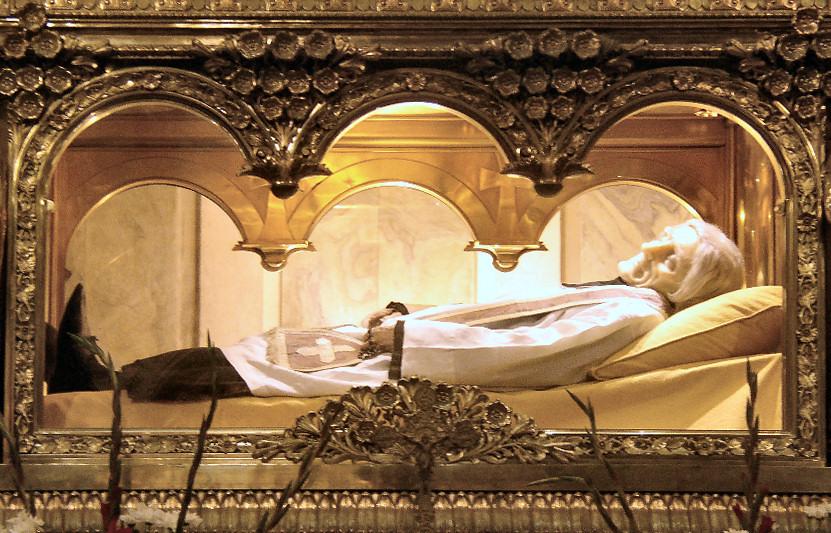
He died at the age of 73 in 1859, and his body remains incorrupt.
He was a counter-revolutionary priest because he understood that malice can only be countered with the military action inherent in each duty of state.
The best biography of the holy Curé of Ars is undoubtedly the one written by Francis Trochu: "The Curé of Ars."
Let us ask, let us pray to God that we may never lack priests for the Church; faithful, holy, penitent, self-sacrificing priests, not complacent with the world, zealous to save all possible souls, becoming "all things to all people" and always looking towards Heaven.
Therefore, let us publicly pray a prayer that I learned years ago:
Jesus, give us holy priests.
– To increase our faith, give us holy priests.
– To baptize our children, give us holy priests.
– To celebrate Holy Mass, give us holy priests.
– To forgive our sins, give us holy priests.
– To confirm our young people, give us holy priests.
– To marry our sweethearts, give us holy priests.
– To visit our sick, give us holy priests.
– To multiply the sacraments, give us holy priests.
– To preach the truth with courage, give us holy priests.
Let us ask the Blessed Virgin Mary that, from among our families, young people may emerge, like a stalk of spikenard, willing to give their lives for the greater glory of God and the salvation of souls, saying YES to God, should He call them to the priestly or religious vocation.
Fr. Javier Olivera Ravasi SE is incardinated in the Diocese of San Francisco. He is a co-founder of the Order of Saint Elias. A native of Argentina, he blogs at QueNoTeLaCuenten