Shouldn't Trump Criticize Pope Leo?
Trump says he doesn't want a "Pope who thinks it's okay for Iran to have a nuclear weapon." But did the Pope say that?
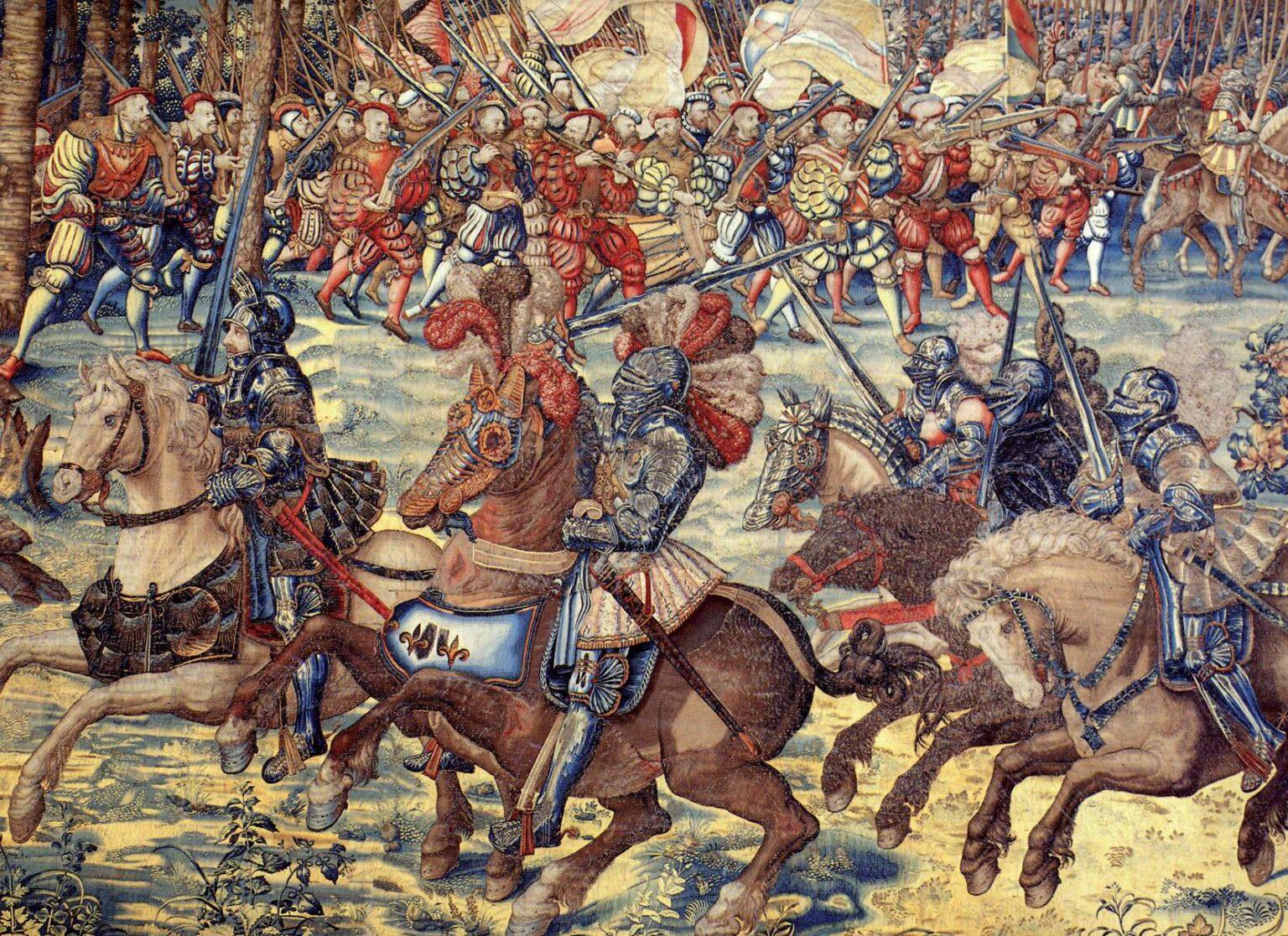
Battle of Pavia, 1525.
About the recent kerfuffle involving criticisms President Donald Trump leveled at Pope Leo XIV, I feel that the president’s statements were intemperate, if not actually wrong. But it begs the question: shouldn’t a politician be able to criticize the Pope? Read further for an answer.
Writing in a social media post on April 12, Trump slammed the Pope on a Sunday evening, writing: “I don’t want a Pope who thinks it’s OK for Iran to have a Nuclear Weapon.” Later that night, Trump told the media, “We don’t like a pope that’s gonna say that it’s okay to have a nuclear weapon.” Over several days of media attention to the debate between the pontiff and the president, Trump’s message changed. On April 17, he stated that he has “nothing against the pope” but that “I have to do what’s right.” Then he added, “I’m not fighting with him. The pope made a statement. He says Iran can have a nuclear weapon. I say Iran cannot have a nuclear weapon.” This came despite repeated statements by Pope Leo denouncing nuclear weapons and defense spending.
When Trump described the Pope on social media as "weak on crime" and "terrible for foreign policy," the pontiff said he has "no fear" of the Trump administration. He also denounced politicians who "manipulate religion and the very name of God for their own military, economic and political gain". Saying that he is not a politician, the Pope said he is focusing on the “Message of the Gospel” and promoting peace. Indeed, this was built upon the Pope’s Palm Sunday message in which he said: “Brothers and sisters, this is our God: Jesus, King of Peace, who rejects war, whom no one can use to justify war,” Leo said. “He does not listen to the prayers of those who wage war, but rejects them, saying: ‘Even though you make many prayers, I will not listen: your hands are full of blood.’” In these statements, Leo did not name Trump nor any other political leader specifically.
But Leo’s predecessors were not afraid to engage in politics, or even to intervene in war. The example set by one of the most controversial pontiffs is illustrative.
Pope Clement VII, whose birth name was Giulio di Giuliano di Medici and who was a scion of the infamous Medici family, reigned during one of the most turbulent times in Europe and the Church. Spain had started colonies in the Americas, the Protestant Reformation was in full swing, and the Vatican was nearly bankrupt. Holy Roman Emperor Charles V was engaged in a conflict with King Francis I of France, Ottoman Emperor Suleiman invaded Eastern Europe, Henry VIII of England demanded a divorce from Catherine of Aragon to marry Anne Boleyn, and mutinous troops of Charles V sacked Rome when Clement would not support the emperor. As Martin Luther’s doctrines riled Germany, popular support for Clement and the papacy declined there, exacerbated when Clement exacted tithes for his extravagant art patronage, including Michelangelo’s murals in the Sistine Chapel.
Clement initially supported Charles V in his struggles with the French king for control of Europe. But Clement shifted his support from one to the other whilst seeking to maintain his control of the Papal Estates in Central Italy. Clement supported the emperor, for instance, in fighting that ended with the Battle of Pavia in 1525, when Francis was taken prisoner. In 1526, he co-founded the League of Cognac with Francis in opposition to Charles, exacerbating the Pope’s struggles in fractious Germany and against Protestantism. Clement’s alliance with France led to the emperor’s sack of Rome in May 1527. Seeking refuge in Castel Sant’Angelo, Clement lived outside Rome for nearly a year.
France was Catholic, but it supported Spain's enemies to weaken Charles V. France supported the Muslim Ottoman Empire, while Pope Clement allied himself with the French against Charles V. What Pope Clement was doing was not something against the emperor alone, but against Christendom, because if the Turks triumphed, Europe would fall into the hands of Islam. Therefore, Clement was not supporting Charles, the defender of Christendom, but was collaborating with the Muslim Turks and the French against Christendom. When Clement had fled to Castel Sant’Angelo, he wrote to Charles V, saying: "I do not understand how a Christian prince like you allowed me to be outraged as they did. This is unacceptable." Charles V responded by telling him that His Holiness was not acting as vicar of Christ but as an enemy of Christendom, since he was allied with those who wanted to destroy the Church. The emperor wrote: "When you are a shepherd, I will respect you. But when you are part of it, I will fight you." It was as if to say, "if you collaborate in the defense of Christendom and are vicar of Christ, you have my support. If instead you join the enemy, you will be fought."
In the current disagreement between the Pope and the most powerful political figure on the planet, I believe the Pope is right in this specific case. But he could be wrong in the future. It was President Trump who made unwarranted criticisms of the pontiff. Catholics should not fall into either the camp of papolatry or papophobia. The Pope as head of state does not act or speak ex cathedra, as he might in matters of doctrine and morality. Like anyone, he may err in politics. His statements should be analyzed objectively, without falling into either papolatrous or papophobic attitudes.
I support Pope Leo in this latest disagreement with Trump, not because he is the pontiff, but because he is objectively correct and Trump’s criticisms are wrong. However, if tomorrow and in a different context, I side with the president rather than the Pope, it is precisely because the latter is not infallible in political matters. The Pope can be right or wrong about politics. Let us pray that he may always know how to guide our Church along the path of truth and concord.