Sisters Of The Little Way Offer Ministry Of Listening To Others Harmed By The Catholic Church
Sister Danielle Lussier warned Catholics against clericalism, defining it as a dangerous separation between Catholic clergy and laity.
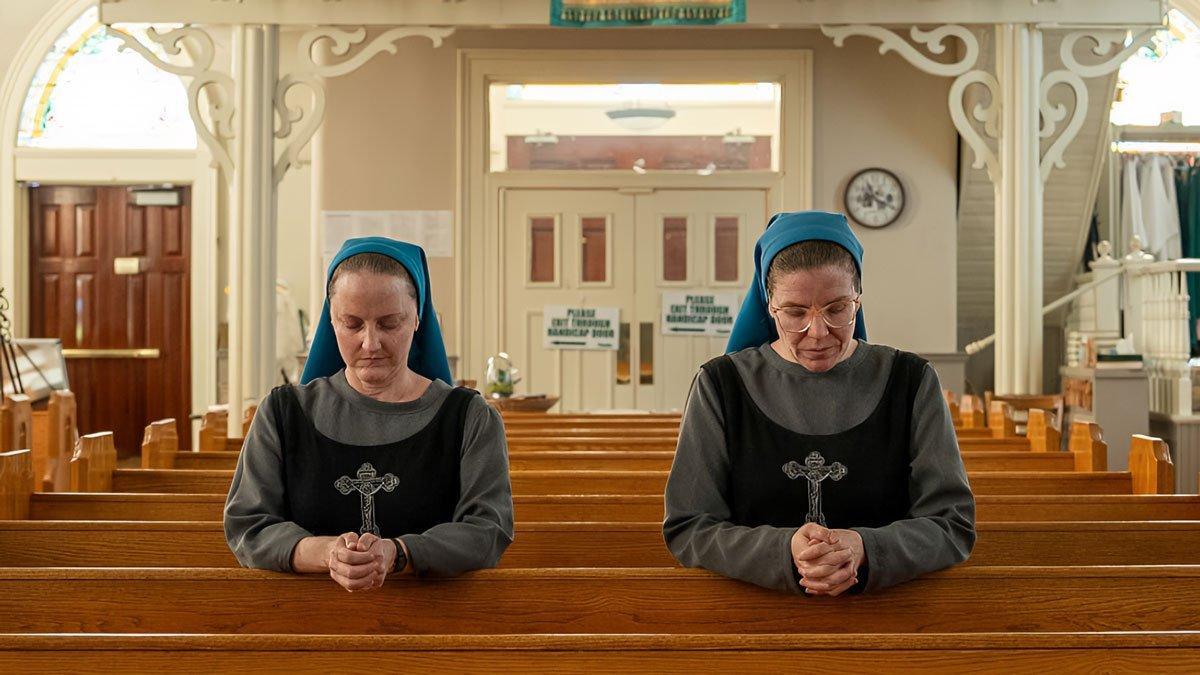
Sisters Theresa Aletheia Noble and Danielle Victoria Lussier said in interviews that they are seeking members for a new religious association dedicated to healing those wounded by members of the Church.
Faced with the need for healing among adult Catholics harmed physically and spiritually by members of the Church, the two women are the founders of the Sisters of the Little Way of Beauty, Truth and Goodness, which is a private association of the faithful intending to become a religious institute approved by the Diocese of Lexington, Kentucky. They are actively raising awareness and seeking funds.
Speaking outside of St. Thomas the Apostle Parish church in Ann Arbor, Michigan, Lussier greeted parishioners and said, “We’ve been connecting with people across the world and studied in Rome under Fr. Hans Zollner,” and have heard dozens of testimonies of spiritual, psychological, and sexual abuse of adults. She said Zollner’s resignation from the Pontifical Commission for Protection of Minors in 2023 showed how it is possible to remain dignified and remain in the Church while insisting on transparency in protecting the vulnerable.
Noble said that about a third of the survivors who contact the sisters are survivors of abuse in religious life. Based on the experience of speaking with these survivors, she believes that the vow of obedience should be explored theologically in light of the abuses taking place in religious communities.
She referred to the work of theologian Father Samuel Fernandez, who wrote that victims of abuse are not guilty for what they have undergone, and that religious authorities have sometimes misused the vow of obedience.
“We’ve seen this with the Legionnaires of Christ,” she said. “ Their founder, Marcial Maciel, used the vow of obedience and two additional vows that he added to manipulate those beneath him.” Noble will be submitting a proposal to study the issue at the Gregorian University, and said, “I think these issues are at the epicenter of this. If you look at the context of the Catholic Church, religious life is the situation most vulnerable to spiritual and sexual abuse, and abuses of conscience and power.”
Noble warned against clericalism in a video, defining it as a dangerous separation of the clergy from the laity that grants them excessive trust, rights, authority, and responsibility.
Both women spent years in the Daughters of St. Paul, a religious congregation focused on media. Both alleged their spiritual director, former Superior General of the Oblates of the Virgin Mary, Fr. David Nicgorski, used “sexualized” language with them. They joined a third woman, who had alleged sexual assault, to take concerns to superiors. In 2017, the Daughters of St. Paul announced that “credible allegations” were made against Nicgorski and that he would no longer provide spiritual direction to them.
In 2018, the Daughters of St. Paul provided affidavits to the Archdiocese of Boston and the Vatican’s Dicastery for Institutes of Consecrated Life about Nicgorski’s behavior. After examining their allegations, the dicastery wrote that Nicgorski had a “respectable defense,” and that little could be done.
However, in May 2023, the Holy See prohibited Nicgorski “from carrying out the ministry of spiritual direction for five years.”
Both Noble and Lussier said that the restriction was insufficient. Having themselves experienced harm from Church clergy and heard survivors’ stories, they left the Daughters of St. Paul in 2022 and founded their association in 2023 with the intention of creating a religious institute.
They say they were inspired by a 2010 address Pope Benedict XVI gave to the curia, who said the Church is “stained with dust..her garment is torn by the sins of priests…We must accept this humiliation as an exhortation to truth and a call to renewal. Only the truth saves. We must ask ourselves what we can do to repair as much as possible the injustice that has occurred. We must ask ourselves what was wrong in our proclamation…to allow such a thing to happen.”
In 2024, Bishop John Stowe OFM Conv. recognized their private association of lay faithful, praising their mission “of listening, healing outreach, spiritual reparation, and solidarity with modern-day anawim: people on the fringes or outside of the Church, and especially those people who have been wounded, scandalized, or abused by members of the Church.” Anawim is a Hebrew word translated as “the poor” and “the afflicted.” They are allowed to wear habits, ask for donations, and live in a former diocesan rectory.
The next step for the Sisters of the Little Way is official recognition from Vatican authorities. They are expecting several postulants beginning in 2028 after they fundraise to build or buy a convent that will have enough room for new vocations.
In a podcast series titled “Descent into Light,” Noble and Lussier present the issue of adult abuse in the Church by describing their own stories of grooming and abuse, as well as interviewing experts on the subject. Lussier explained that bioluminescent creatures of the deep sea inspire the podcast’s title. “Survivors are like these fish, who communicate with each other and protect themselves with their bioluminescence. They can see in the dark, and they can hold the light, and they can’t unsee what they have seen,” Lussier said. “It is not so much that we are going out to the fringes of the Church to bring the light, but actually it is the fringes of Christ’s garment that heal. These fringes of the Church hold a hard-won wisdom that, although they have been dismembered and lost a sense of belonging, they hold something essential for the Church’s renewal. That hard-won wisdom is something that they can’t unsee,” she added.“
Others need to see what they can’t unsee. They bear a burden on their shoulders that we need to bear and distribute appropriately,” Lussier said. She aims to dispel assumptions among people about sexual, psychological, and spiritual abuse within the Church.
“We try to get people way outside of what they think the story is about because it gets them into the experience of the survivor rather than looking at it from an institutional perspective of what to do with all the people involved,” she said.
Both Noble and Lussier cautioned that they are not psychologists or therapists, but offer to listen to survivors’ accounts in confidentiality. “We listen in solidarity with people on the fringes of the Church, especially the wounded, harmed, and abused by members of the Church. It is, for us, a first step in evangelization in a spirit of repair, renewal, and reparation. And it begins with listening,” Lussier said.
Lussier said adult survivors of abuse have been candid. One former sister shared that a woman who left her religious congregation and was ignorant of life outside the convent was nearly swept into sex trafficking, but was able to escape. A deacon shared that he had been sexually abused by a priest decades before and felt that listening to “Descent Into Light” was the first time anyone ever “spoke” to him about his abuse.
Noble said the scandal of sexual abuse has led people away from the Church. Despite being raised in the faith, she became an atheist in her college years. In graduate school, she returned to the faith. “Part of the reason I became an atheist was because of the hypocrisy I saw in the Church. When I was young, I saw the dark underbelly of the Church and was scandalized. So, I can understand how scandal has led people away from the Church, more than we realize,” she said.
Noble said that she believes religious congregations should include formation for their members about the existence of grooming and spiritual abuse among adults. “Creating awareness about these issues would create safeguards to prevent abuse,” she said.
Martin Barillas is an independent journalist. He is the author of the novel 'Shaken Earth'.