A Spanish Parish Celebrates Feast of the Assumption with Contemporary Dance Performance
Dubbed 'The Magic Flight', the performance sought to explore relationships between 'sound, body, space, and ritual.'
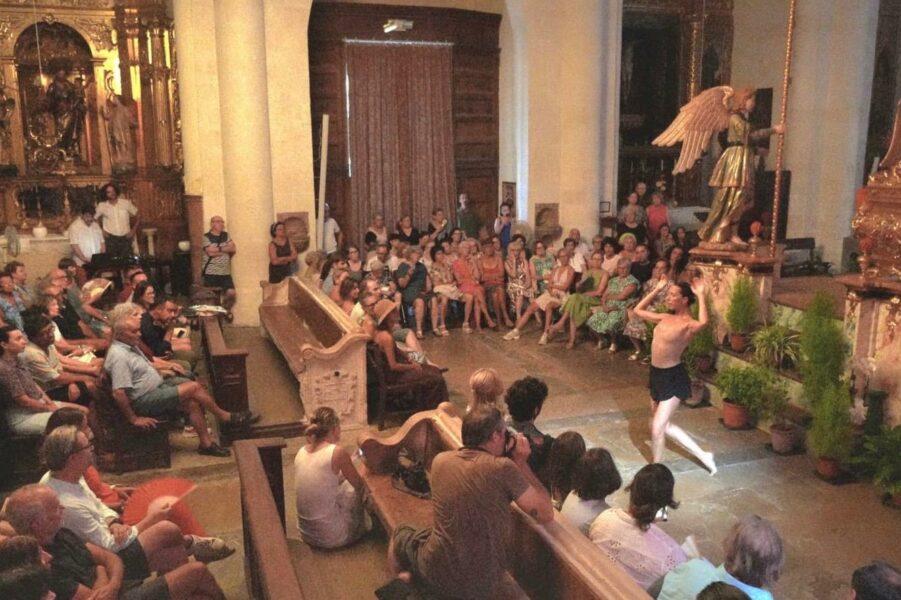
Last week, the Diocese of Mallorca in Spain presented a contemporary dance performance held on August 15—the Solemnity of the Assumption of the Virgin—at the Church of St. John the Baptist in Muro, Mallorca, in Spain's Mediterranean Balearic Islands, as an artistic performance “specifically conceived for the liturgical context.”
The performance, titled *El Vol Màgic* (The Magic Flight), was held within the historic worship space, rather than a music hall or stage. Both the official program and the information subsequently released by the diocese explicitly place it within the celebration of the feast of the Assumption. A statement released by the Diocese of Mallorca says that it was conceived for the “liturgical context of the celebration of the Assumption of the Virgin,” while the government Consell de Mallorca announced it as a performance “integrated into the liturgy.”
“Sound, Body, Space, and Ritual”
El Vol Màgic was directed by musician and anthropologist Txema González and developed in collaboration with dancer and choreographer Mar Aguiló, with the participation of organist Rafel Riera.
According to the diocese, the project arose from research into one of the rituals of Mallorca’s cultural heritage and sought to explore the relationships between “sound, body, space, and ritual.” During the performance, the live sound composition and the organ “engaged in a dialogue with the church’s architecture and the liturgical celebration.”
Also participating in the project were Sebastià Riutort, archivist of Muro, who was in charge of historical documentation, and Carlos Anguera, responsible for sound spatialization and technical support. The private non-profit ACA Foundation and the City Council of Muro collaborated on the performance.
The diocese itself notes that it had the support of Father Gerard Bestard Muntaner, pastor of the parish in Muro.
A Performance Scheduled for the Liturgy of the Assumption
Nor was it an impromptu initiative during the celebration. The performance had been scheduled in advance for 8:00 p.m. on August 15 as part of the activities organized to mark the Solemnity of the Assumption. The Consell de Mallorca’s program already described it at that time as “a contemporary dance and sound art performance integrated into the liturgy of the Feast of the Assumption.”
Dance in the Liturgy
In the past, the Holy See specifically addressed the introduction of dance into the Western liturgy half a century ago. In a text published in Notitiae in 1975, the then Congregation for Divine Worship distinguished between those cultures in which dance retains a distinctly religious character and the Western tradition, where its incorporation into the liturgical celebration introduces an element foreign to the cultural nature of dance.
The general principle, in any case, is outlined in number 22 of the constitution Sacrosanctum Concilium: “No one, even a priest, may add, remove, or change anything in the liturgy on his own initiative.”
The instruction Redemptionis Sacramentum, published in 2004 by the Congregation for Divine Worship and the Discipline of the Sacraments, reiterated that the celebration of the Eucharist is not left to the individual creativity of priests or the faithful.
Just days later, on August 26, Pope Leo dedicated his remarks to the reasons behind the liturgical reform promoted by the Second Vatican Council, marking the final catechesis in his series on the constitution Sacrosanctum Concilium. Addressing pilgrims gathered in St. Peter’s Basilica, the Pope affirmed that this reform stands "within the stream of the Church’s living tradition" and maintained that a proper understanding of it also makes it possible to "reject the abuses" that emerged in certain quarters during the post-conciliar period—abuses which, he warned, "unfortunately still occur today."