What Catholics Should Know About Using Latin In The Mass
Using Latin in liturgies shouldn't be a matter of concern, but a point of unity.
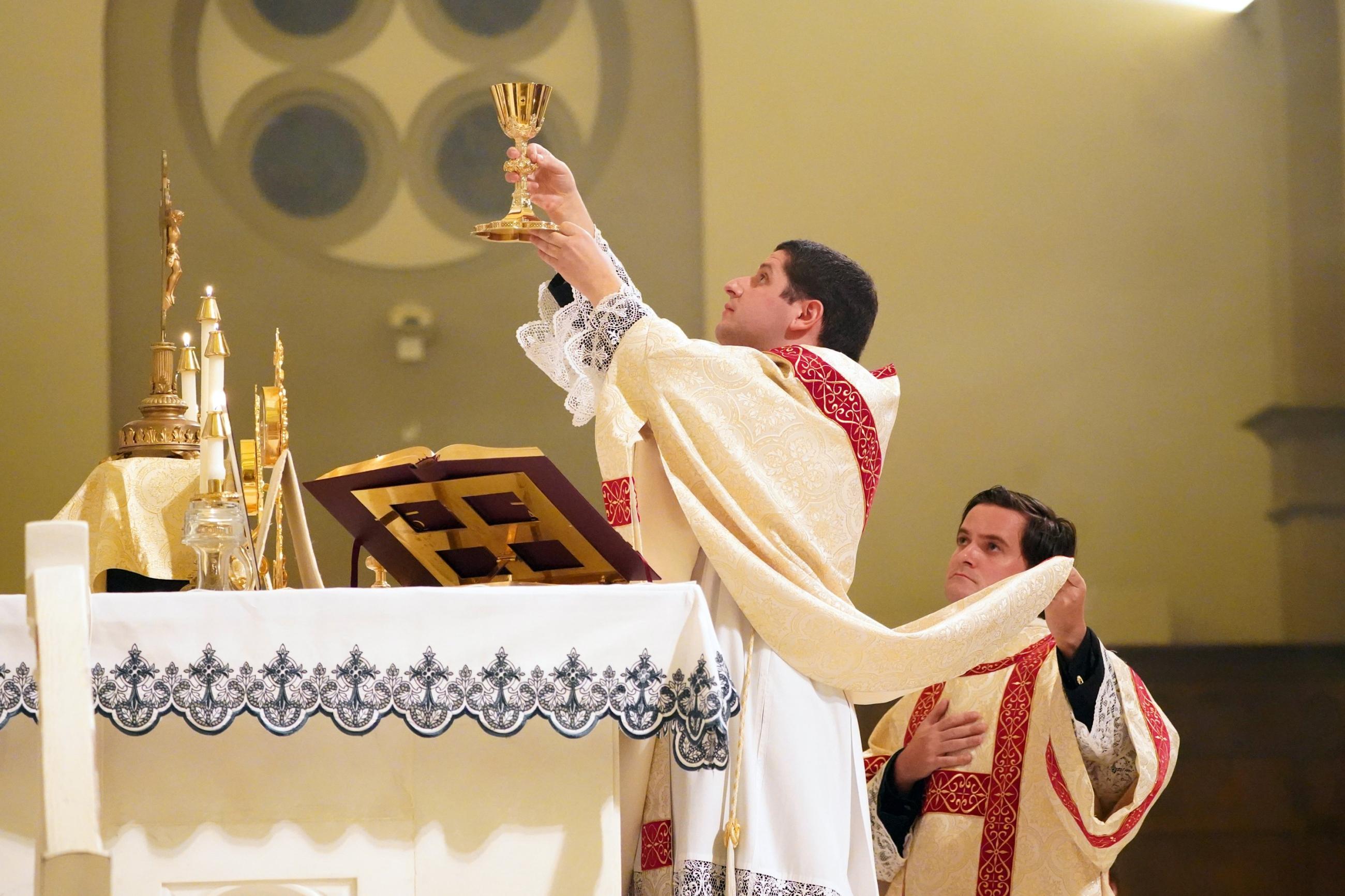
I have been packing up books and moving them in preparation for some painting and work on the upper floors of the rectory, and I came across one of the older worship books that was in use about 20 years ago.
What I found interesting was that the Latin text for the various Mass parts such as the Kyrie (which is actually in Greek), Memorial Acclamation, and the Lamb of God (Agnus Dei) were pasted on the inside front cover of the hymnals. It took a lot of work to go through the hundreds of hymnals to do this! Why? Did not Vatican II get rid of all the Latin in the liturgy?
I have spoken with some Catholics who wondered about this. Actually, while it is true that one of the main documents of Vatican II, named Sacrosanctum Concilium, lays down specific reforms of theliturgy, it never envisioned ending the use of Latin in the liturgy. Here is what the document says in paragraph 36: “The use of the Latin language is to be preserved in the Latin rites.” Later in the same document, in paragraph 54, while it encourages and permits translations of the Latin Rite into the vernacular, it also adds, “Nevertheless, steps should be taken so that the faithful may also be able to say or to sing together in Latin those parts of the ordinary of the Mass which pertain to them.”
What parts pertain to the faithful? Those parts of the Mass that we either sing or pray together, namely, the Kyrie, the Creed, the Sanctus (Holy, Holy, Holy), the Memorial Acclamation prayed after the consecration of the bread and wine into the Sacred Body and Blood of Jesus, the Our Father, and the Lamb of God (Agnus Dei). The same document states in paragraph 116, “The Church acknowledges GregorianChant as specially suited to theRoman Liturgy: therefore, other things being equal, it should be given pride of place in liturgical services.”
Unfortunately, with the excitement going on in the 1960s, the use of Latin was indeed neglected. Thisdisturbed Pope St.Paul VI so much that he offereda shortbooklet for the faithful to be distributed worldwide called Jubilate Deo to help the faithful to chantthe various Mass parts that pertained to them inLatin.These are some of the various Mass parts we are using at the 9:30 a.m. and11:30 a.m. Masses here at St. Thomas.
Since Vatican II, more has been written about this. It is important that we all understand what we are saying at Mass. Full, conscious, and active participation of the faithful was one of theprimary purposesofreforming theliturgy in the first place. And yet, we also understand that we are participating in something very ancient in terms of its structure and form, going all the way back to the Last Supper and even before, since the roots of the Last Supper Passover meal stretch back even further to the days of Moses and the Israelites leaving Egypt. The Jewish people during thetimeofJesus, while speaking the vernacular, always prayed and sang the psalms in Hebrew. We continue to use that language in our liturgy today when we say or sing “Amen” or “Alleluia” or “Hosanna.” So we all know some Hebrew! We also use some Greek, for when Jesus lived, the vernacular throughout theRoman Empire was Greek (not Latin!). The New Testament was written in Greek, the common language of theRoman Empire. The liturgy throughout the Church was in Greek. Only later, in the fourth century, do we see a shift in the West (Rome) to the use of Latin in the liturgy. Pope St. Damasus even commissioned St. Jerome to translate the Sacred Scriptures from Hebrew and Greek into Latin. We have the Latin Vulgate with us today as a result of that incredible effort.
Why did the Pope do this? So the People of God could hear and understand the Sacred Scriptures in their native tongue! Hearing and understanding God’s Word is what is most important. And yet, there is a gift of loving respect for the work God has done. We still use Greek at the beginning of the liturgy when we sing or say “Lord have mercy” in Greek: “Kyrie Eleison!”
I think it is marvelous that the liturgy contains a living memory of God’s working in his people throughout the centuries, and that the Holy Spirit, who speaks in all tongues, continues and furthers that work in us in our English tongue! Rather than seeing the use of Latin as a matter of concern, I would hope that we experience it as a point of unity. The Latin Rite liturgy is celebrated the same throughout the world in the various tongues that are currently present on the earth, as well as some prayers being chanted or prayed in Latin.Those same prayers have been on the tongues of many thousands of saints and millions of believers throughout the ages.
Let’s rejoice in that and ponder that our Good Lord has chosen each of us to participate in this mighty chorus, all to his praise and glory!
Fr. William Asbaugh is pastor of St. Thomas the Apostle Parish in Ann Arbor, Michigan.